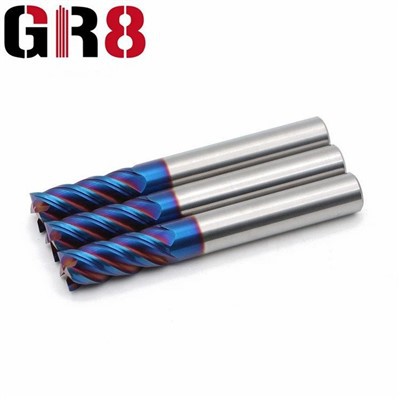
Hey there! As a supplier of flat carbide cutting tools, I often get asked about the cutting mechanism of these nifty tools. So, I thought I'd take a deep dive into this topic and share some insights with you all.
First off, let's talk about what flat carbide cutting tools are. These tools are made from carbide, which is a super-hard material composed of carbon and a metal like tungsten. They're known for their durability, high heat resistance, and ability to cut through a wide range of materials, from metals to plastics.
The cutting mechanism of flat carbide cutting tools is based on the principle of shearing. When the tool comes into contact with the workpiece, the sharp edges of the carbide insert apply a force that causes the material to deform and eventually break away in small chips. This process is similar to how a pair of scissors cuts through paper, but on a much smaller and more precise scale.
Let's break down the cutting process into a few key steps:


1. Engagement
The first step is when the cutting tool makes contact with the workpiece. The shape and design of the flat carbide cutting tool play a crucial role here. For example, a 2 Flutes Flat End Mill is designed with two cutting edges that start to dig into the material. The angle at which the tool approaches the workpiece, known as the rake angle, affects how easily the tool can penetrate the material. A positive rake angle means the cutting edge is angled in a way that helps it slice into the material more smoothly, reducing the cutting force required.
2. Deformation
Once the tool is engaged, the material in front of the cutting edge starts to deform. This deformation is a combination of elastic and plastic deformation. Elastic deformation is like when you stretch a rubber band and it goes back to its original shape. But as the cutting force increases, the material reaches its yield point and undergoes plastic deformation. This means it doesn't return to its original shape and starts to flow around the cutting edge.
3. Chip Formation
As the material continues to deform, it eventually breaks away from the workpiece in the form of chips. The type of chip formed can tell us a lot about the cutting process. There are different types of chips, such as continuous chips, segmented chips, and discontinuous chips. Continuous chips are usually formed when cutting ductile materials like aluminum. These chips are long and ribbon-like. Segmented chips are more common when cutting materials with medium ductility, and they look like a series of connected segments. Discontinuous chips are formed when cutting brittle materials like cast iron, and they break into small pieces.
4. Shearing
The actual cutting action is mainly a shearing process. The cutting edge of the flat carbide tool acts like a blade, applying a shearing force to the material. The shearing plane is the area where the material is being cut. The angle of this shearing plane, called the shear angle, is influenced by factors like the rake angle of the tool, the cutting speed, and the properties of the workpiece material. A larger shear angle generally means less cutting force and better chip formation.
5. Heat Generation
Cutting is a process that generates a lot of heat. The friction between the tool and the workpiece, as well as the deformation of the material, contribute to this heat. Flat carbide cutting tools are great at handling heat because of their high heat resistance. However, excessive heat can still cause problems like tool wear and damage to the workpiece surface. That's why coolant is often used during the cutting process to reduce the temperature and improve the cutting performance.
6. Tool Wear
Over time, the cutting tool will start to wear. There are different types of tool wear, such as flank wear, crater wear, and nose wear. Flank wear occurs on the side of the cutting edge that is in contact with the workpiece. Crater wear happens on the rake face of the tool, where the chips slide over. Nose wear affects the tip of the tool. Understanding the cutting mechanism helps us predict and manage tool wear. For example, by adjusting the cutting parameters like cutting speed, feed rate, and depth of cut, we can reduce the rate of tool wear and extend the tool's lifespan.
Now, let's talk about some of the different types of flat carbide cutting tools and how their cutting mechanisms might vary.
Carbide End Mills are widely used in machining operations. They come in different flute configurations, such as 2 flutes, 3 flutes, 4 flutes, and more. The number of flutes affects the cutting performance. For instance, a 65HRC 4 Flutes Flat End Mill is designed for high-hardness materials. The four flutes provide more cutting edges, which can increase the material removal rate. However, they also require more power and can generate more heat compared to a 2-flute end mill.
In conclusion, the cutting mechanism of flat carbide cutting tools is a complex but fascinating process. It involves a combination of mechanical forces, material deformation, and heat generation. As a supplier, I understand the importance of providing high-quality tools that are designed to optimize this cutting process. Whether you're a small workshop or a large manufacturing plant, having the right flat carbide cutting tools can make a big difference in your productivity and the quality of your products.
If you're interested in learning more about our flat carbide cutting tools or have any questions about the cutting mechanism, feel free to reach out. We're always happy to have a chat and help you find the best tools for your specific needs. Let's start a conversation and see how we can work together to improve your machining operations.
References
- Trent, E. M., & Wright, P. K. (2000). Metal Cutting. Butterworth-Heinemann.
- Kalpakjian, S., & Schmid, S. R. (2009). Manufacturing Engineering and Technology. Pearson Prentice Hall.