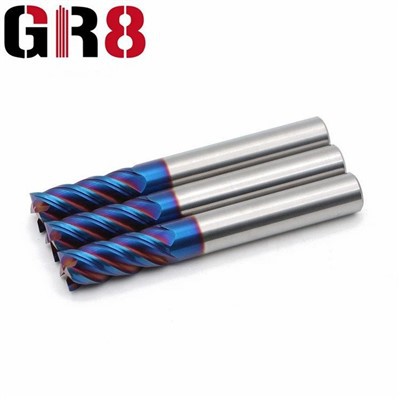
What is the cutting speed of a Mini End Mill?
As a well - established supplier of Mini End Mills, I understand the significance of the cutting speed when it comes to the performance of these small but important tools. Cutting speed is a fundamental concept in machining, and it plays a crucial role in determining the efficiency, quality, and tool life of Mini End Mills.
Understanding Cutting Speed
Cutting speed, often denoted as (V_c), refers to the speed at which the cutting edge of the tool moves through the workpiece material. It is usually measured in surface feet per minute (SFM) or meters per minute (m/min). The cutting speed is affected by several factors, including the material of the workpiece, the material of the end mill, the type of operation (such as milling, slotting, or profiling), and the diameter of the end mill.
Mathematically, the cutting speed can be calculated using the formula:
[V_c=\pi DN/1000]
where (V_c) is the cutting speed in m/min, (D) is the diameter of the end mill in mm, and (N) is the rotational speed of the spindle in revolutions per minute (RPM).
Factors Affecting the Cutting Speed of Mini End Mills
Workpiece Material
Different workpiece materials have different characteristics, such as hardness, toughness, and thermal conductivity. Harder materials generally require lower cutting speeds to avoid excessive tool wear and breakage. For example, when machining aluminum alloys, which are relatively soft, the cutting speed can be significantly higher compared to machining stainless steel or titanium alloys. Aluminum may allow cutting speeds of 300 - 1000 SFM, while stainless steel might require speeds in the range of 50 - 200 SFM.
End Mill Material
The material of the Mini End Mill also has a major impact on the cutting speed. Common end - mill materials include high - speed steel (HSS), cobalt - high - speed steel (Co - HSS), and carbide. Carbide end mills are extremely hard and heat - resistant, allowing for much higher cutting speeds compared to HSS end mills. For instance, a carbide Mini End Mill can operate at cutting speeds 2 - 3 times higher than an HSS end mill when machining the same workpiece material.
Type of Operation
The specific operation being performed with the Mini End Mill affects the cutting speed as well. In roughing operations, where large amounts of material need to be removed quickly, a lower cutting speed may be used to ensure the tool can withstand the higher cutting forces. In finishing operations, where a high - quality surface finish is required, a higher cutting speed can be employed to minimize tool marks and achieve a smoother surface.
End Mill Diameter
The diameter of the Mini End Mill is directly related to the cutting speed. Smaller diameter end mills generally have lower cutting speeds because they are more prone to breakage and have less cutting edge engagement. For example, a Mini End Mill with a diameter of 0.5 mm may have a lower optimal cutting speed compared to a 2 mm diameter end mill when machining the same material.
Recommended Cutting Speeds for Mini End Mills
For our 2 Flutes Ball Nose Micro - diameter Endmill, when machining aluminum, a cutting speed in the range of 600 - 800 SFM (180 - 240 m/min) is often recommended. This allows for efficient material removal while maintaining a good surface finish. When machining brass, the cutting speed can be slightly higher, around 800 - 1000 SFM (240 - 300 m/min).
Our 2 Flutes Flat Micro - diameter Milling Cutter is suitable for a variety of machining operations. When milling mild steel, a cutting speed of 100 - 150 SFM (30 - 45 m/min) is a good starting point. For plastic materials, cutting speeds can be quite high, reaching up to 1000 - 1500 SFM (300 - 450 m/min).
The 2 Flutes Flat Micro - diameter Milling Cutter can also be used for precision machining of different materials. When working with titanium alloys, due to their high strength and poor thermal conductivity, the cutting speed should be kept relatively low, typically in the range of 20 - 50 SFM (6 - 15 m/min).
Importance of Choosing the Right Cutting Speed
Selecting the appropriate cutting speed is vital for several reasons. Firstly, it affects the tool life. If the cutting speed is too high, the end mill will experience excessive heat generation and wear, leading to premature tool failure. On the other hand, if the cutting speed is too low, the machining process will be inefficient, and the surface finish of the workpiece may be poor.
Secondly, the cutting speed impacts the surface quality of the machined part. A proper cutting speed helps to reduce tool marks and chatter, resulting in a smoother and more precise surface finish. This is especially important in industries such as aerospace and medical, where high - precision components are required.
Lastly, the cutting speed is related to the overall productivity of the machining process. By choosing the optimal cutting speed, more material can be removed in less time, increasing the production rate and reducing costs.
How to Determine the Best Cutting Speed
Determining the best cutting speed for a Mini End Mill requires a combination of theoretical knowledge and practical experience. Machinists can start by referring to the tool manufacturer's recommendations, which are usually based on extensive testing and research. These recommendations take into account the end - mill material, geometry, and the most common workpiece materials.


In addition, trial cuts can be performed on a sample workpiece. By gradually adjusting the cutting speed and observing the tool wear, surface finish, and cutting forces, the optimal cutting speed can be determined. Modern machining centers are often equipped with sensors and monitoring systems that can provide real - time feedback on the cutting process, helping to fine - tune the cutting speed.
Conclusion and Call to Action
In conclusion, the cutting speed of a Mini End Mill is a critical parameter that significantly affects the machining process. By understanding the factors that influence cutting speed and choosing the appropriate values, machinists can achieve better tool life, higher surface quality, and increased productivity.
As a leading supplier of Mini End Mills, we are committed to providing high - quality products and technical support. Our team of experts can help you select the right Mini End Mill for your specific application and provide guidance on the optimal cutting speed. If you are interested in purchasing our Mini End Mills or have any questions about cutting speeds, please feel free to contact us for a detailed discussion and procurement negotiation.
References
- "Machining Handbook", Industrial Press Inc.
- "Cutting Tool Engineering", Society of Manufacturing Engineers.