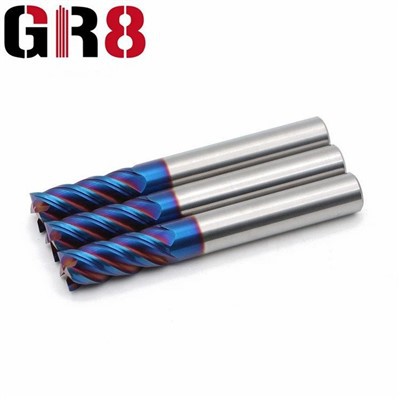
Can a Taper Ball Nose Endmill be used for pocketing?
Hey there, folks! As a supplier of Taper Ball Nose Endmills, I often get asked this question: Can a Taper Ball Nose Endmill be used for pocketing? Well, let's dive right in and find out.
First off, let's understand what a Taper Ball Nose Endmill is. It's a cutting tool with a tapered shape and a ball-shaped tip. This unique design gives it some distinct advantages over other types of endmills. The tapered part allows for better access to hard-to-reach areas, while the ball nose provides a smooth finish on curved surfaces.
Now, when it comes to pocketing, which is the process of creating a cavity or pocket in a workpiece, a Taper Ball Nose Endmill can indeed be a great choice. One of the main benefits is its ability to create rounded corners in the pocket. Unlike square endmills that leave sharp corners, the ball nose of the taper endmill can produce a more aesthetically pleasing and stress - relieved pocket.
In terms of machining efficiency, the taper design helps in reducing the cutting forces. When you're cutting a pocket, especially a deep one, high cutting forces can cause vibrations, which in turn can lead to poor surface finish and even tool breakage. The taper on the endmill allows for a more gradual engagement with the material, spreading out the cutting forces over a larger area. This results in smoother cutting and less wear on the tool.
Another advantage is the versatility it offers. You can use a Taper Ball Nose Endmill for both roughing and finishing operations in pocketing. For roughing, you can take relatively large cuts to remove the bulk of the material quickly. And when it comes to finishing, the ball nose can create a fine surface finish on the walls and bottom of the pocket.
Let's talk about the types of materials that a Taper Ball Nose Endmill can handle for pocketing. It works well with a wide range of materials, including aluminum, steel, and even some plastics. For example, in the aerospace industry, where aluminum parts with complex pockets are common, a Taper Ball Nose Endmill can be used to machine these parts with high precision.
However, like any tool, there are also some considerations when using a Taper Ball Nose Endmill for pocketing. One of the main things is the depth of the pocket. If the pocket is too deep, the long taper of the endmill might cause deflection, which can affect the accuracy of the pocket. In such cases, you might need to use a shorter endmill or adjust the cutting parameters.
Also, the feed rate and spindle speed need to be carefully selected. If the feed rate is too high, the endmill might not be able to remove the material properly, leading to a poor surface finish. On the other hand, if the spindle speed is too low, it can cause excessive heat generation, which can damage the tool and the workpiece.
Now, let me tell you about some of the products we offer. We have the 2F Taper Ball Nose Endmill with Coating. The coating on this endmill provides several benefits. It increases the tool's hardness, which means it can withstand higher cutting forces and last longer. It also reduces friction between the tool and the material, which helps in improving the surface finish of the pocket.
We also have the 2F Taper Ball Nose Milling Cutter Without Coating and the 2F Taper Ball Nose Milling Cutter without Coating. These uncoated endmills are a great option if you're working with softer materials or if you're on a budget. They still offer good performance and can be used effectively for pocketing operations.
In conclusion, a Taper Ball Nose Endmill can definitely be used for pocketing, and it has many advantages over other types of endmills. Whether you're a small - scale workshop or a large manufacturing plant, it's a tool worth considering for your pocketing needs.


If you're interested in learning more about our Taper Ball Nose Endmills or if you're looking to make a purchase, don't hesitate to reach out. We're here to help you find the right tool for your specific application. Let's start a conversation and see how we can work together to improve your machining processes.
References:
- "Machining Handbook" by Industrial Press Inc.
- Various industry research papers on endmill performance in pocketing operations.