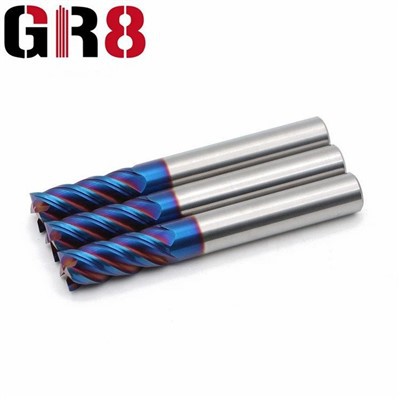
In the realm of machining, the choice of cutting tools significantly impacts the quality and efficiency of the process, especially when working with soft materials. Among the various cutting tools available, the Taper Ball Nose Endmill stands out as a versatile and effective option. As a supplier of Taper Ball Nose Endmills, I have witnessed firsthand the remarkable performance of these tools in soft material machining. In this blog, I will delve into how a Taper Ball Nose Endmill performs in soft materials, exploring its features, advantages, and practical applications.
Understanding the Taper Ball Nose Endmill
Before discussing its performance in soft materials, it's essential to understand what a Taper Ball Nose Endmill is. A Taper Ball Nose Endmill has a tapered shape that gradually reduces in diameter towards the tip, and the tip is rounded like a ball. This unique design combines the benefits of a tapered endmill and a ball nose endmill, offering enhanced versatility and precision in machining operations.
The taper of the endmill allows for more efficient chip evacuation, especially in deep pocket milling. The ball nose tip, on the other hand, enables smooth contouring and finishing, making it suitable for creating complex shapes and curved surfaces. These features make the Taper Ball Nose Endmill an ideal choice for a wide range of applications, including mold making, aerospace components manufacturing, and medical device production.
Performance in Soft Materials
Soft materials, such as aluminum, brass, copper, and plastics, have different machining characteristics compared to hard materials. They are generally more ductile and have lower cutting forces, which means that the cutting tools used for soft materials need to be designed to handle these properties effectively.
1. Chip Formation and Evacuation
One of the key challenges in machining soft materials is chip formation and evacuation. Soft materials tend to produce long, stringy chips that can clog the flutes of the endmill, leading to poor surface finish, increased cutting forces, and tool wear. The tapered design of the Taper Ball Nose Endmill helps to address this issue by providing more space for chip evacuation. As the chips are formed, they are more easily pushed out of the cutting zone, reducing the risk of chip clogging and improving the overall machining efficiency.
For example, when milling aluminum with a Taper Ball Nose Endmill, the tapered flutes allow the chips to flow smoothly along the tool, preventing them from accumulating and causing problems. This results in a cleaner cutting process and a better surface finish on the workpiece.
2. Surface Finish
The ball nose tip of the Taper Ball Nose Endmill is particularly well-suited for achieving excellent surface finishes in soft materials. The rounded tip allows for smooth contouring and blending, minimizing the appearance of tool marks and producing a high-quality surface. This is especially important in applications where aesthetics and precision are crucial, such as in the production of consumer electronics and automotive components.


In addition, the Taper Ball Nose Endmill can be used for finishing operations, where it can remove the remaining material after rough machining and create a smooth, polished surface. The ability to achieve a fine surface finish in a single pass reduces the need for additional finishing operations, saving time and cost.
3. Tool Life
Another advantage of using a Taper Ball Nose Endmill in soft materials is its extended tool life. Soft materials are generally less abrasive than hard materials, which means that the cutting edges of the endmill are subjected to less wear. However, the design of the Taper Ball Nose Endmill also plays a role in its tool life. The tapered shape distributes the cutting forces more evenly along the tool, reducing the stress on the cutting edges and preventing premature wear.
Moreover, many Taper Ball Nose Endmills are coated with advanced materials, such as titanium nitride (TiN) or titanium aluminum nitride (TiAlN), which further enhance their wear resistance and tool life. These coatings provide a hard, protective layer that reduces friction and heat generation during cutting, resulting in longer tool life and lower machining costs.
Applications in Soft Material Machining
The Taper Ball Nose Endmill's excellent performance in soft materials makes it suitable for a wide range of applications. Here are some examples:
1. Mold Making
In mold making, the Taper Ball Nose Endmill is used to create complex shapes and contours in soft materials such as aluminum and brass. The tapered design allows for efficient machining of deep pockets and cavities, while the ball nose tip enables smooth finishing of the mold surfaces. This results in high-quality molds with precise dimensions and excellent surface finishes.
2. Aerospace Components Manufacturing
Aerospace components often require the machining of soft materials, such as aluminum alloys, to achieve lightweight and high-strength structures. The Taper Ball Nose Endmill is used to machine complex shapes and features in these components, such as airfoils and turbine blades. Its ability to provide excellent surface finishes and extended tool life makes it an ideal choice for aerospace applications.
3. Medical Device Production
Medical devices, such as implants and surgical instruments, are typically made from soft materials, such as titanium and stainless steel. The Taper Ball Nose Endmill is used to machine these materials with high precision and accuracy, ensuring the quality and functionality of the medical devices. Its ability to achieve smooth surface finishes is also important in medical applications, as it reduces the risk of infection and improves the biocompatibility of the devices.
Choosing the Right Taper Ball Nose Endmill
When choosing a Taper Ball Nose Endmill for soft material machining, there are several factors to consider:
1. Taper Angle
The taper angle of the endmill affects its cutting performance and chip evacuation. A larger taper angle provides more space for chip evacuation but may also reduce the cutting stability. A smaller taper angle, on the other hand, offers better cutting stability but may be more prone to chip clogging. The choice of taper angle depends on the specific machining requirements and the type of soft material being machined.
2. Number of Flutes
The number of flutes on the endmill also affects its performance in soft materials. A higher number of flutes generally provides a smoother surface finish but may reduce the chip evacuation capacity. A lower number of flutes allows for better chip evacuation but may result in a rougher surface finish. The number of flutes should be selected based on the desired surface finish and the cutting conditions.
3. Coating
As mentioned earlier, coating the Taper Ball Nose Endmill can significantly enhance its wear resistance and tool life. Different coatings have different properties and are suitable for different applications. For example, TiN coating is a common choice for general-purpose machining, while TiAlN coating is more suitable for high-speed machining and machining of difficult-to-cut materials.
Our Product Offerings
As a supplier of Taper Ball Nose Endmills, we offer a wide range of products to meet the diverse needs of our customers. Our 2F Taper Ball Nose Milling Cutter without Coating is a cost-effective option for general-purpose machining of soft materials. It provides good cutting performance and durability without the added cost of coating.
For applications that require enhanced wear resistance and tool life, we offer the 2F Taper Ball Nose Endmill with Coating and 2F Taper Ball Nose Endmill With Coating. These endmills are coated with advanced materials to provide excellent performance in high-speed machining and machining of difficult-to-cut materials.
Contact Us for Procurement
If you are looking for high-quality Taper Ball Nose Endmills for your soft material machining needs, we would be happy to assist you. Our team of experts can provide you with detailed product information, technical support, and customized solutions to meet your specific requirements. Contact us today to start a procurement discussion and experience the superior performance of our Taper Ball Nose Endmills.
References
- Boothroyd, G., & Knight, W. A. (2006). Fundamentals of machining and machine tools. CRC Press.
- Kalpakjian, S., & Schmid, S. R. (2010). Manufacturing engineering and technology. Pearson.
- Trent, E. M., & Wright, P. K. (2000). Metal cutting. Butterworth-Heinemann.