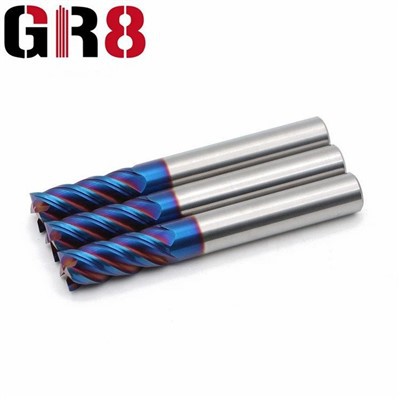
The clearance angle is a crucial geometric parameter in the design of a roughing end mill, which significantly influences its cutting performance. As a leading supplier of roughing end mills, we have in - depth knowledge and extensive experience in understanding how the clearance angle impacts the cutting process. In this blog, we will explore the relationship between the clearance angle and the cutting performance of a roughing end mill.
Understanding the Clearance Angle in Roughing End Mills
The clearance angle of a roughing end mill is defined as the angle between the flank surface of the cutting edge and a line perpendicular to the workpiece surface at the point of cutting. It provides space for the chips to flow out of the cutting zone and prevents the flank surface of the cutting edge from rubbing against the machined surface.
In the design of roughing end mills, different clearance angles are used according to various machining requirements. For example, 3 Flutes Roughing End Mill often has specific clearance angle settings to meet the needs of efficient material removal in roughing operations.
Impact on Chip Formation and Evacuation
One of the primary effects of the clearance angle on the cutting performance of a roughing end mill is its influence on chip formation and evacuation. A proper clearance angle allows the chips to form smoothly and flow out of the cutting zone without being compressed or jammed.
When the clearance angle is too small, the flank surface of the cutting edge will rub against the machined surface, increasing the friction force. This friction not only generates excessive heat but also causes the chips to be compressed, leading to irregular chip shapes. Irregular chips are difficult to evacuate from the cutting zone, which can result in chip clogging. Chip clogging can cause tool wear, surface finish deterioration, and even tool breakage.
On the other hand, a large clearance angle provides sufficient space for chip formation and evacuation. The chips can flow freely along the flute of the end mill, reducing the probability of chip clogging. For instance, in the case of 3 Flutes Roughing Milling Cutter, an appropriate clearance angle ensures that the chips generated during the roughing process can be efficiently removed, improving the overall cutting efficiency.
Effect on Tool Wear
Tool wear is another important aspect affected by the clearance angle. In roughing operations, the cutting forces are relatively large, and the tool is subject to significant mechanical and thermal loads. The clearance angle plays a vital role in determining the wear pattern and rate of the roughing end mill.
A small clearance angle increases the contact area between the flank surface of the cutting edge and the machined surface, leading to higher friction and wear. The flank wear can cause the cutting edge to become dull, increasing the cutting force and reducing the cutting performance. Moreover, the heat generated by the friction can also lead to thermal wear, such as crater wear on the rake face of the cutting edge.
Conversely, a well - designed clearance angle reduces the contact area and friction, thus decreasing the wear rate. This extends the tool life of the roughing end mill. For example, our 3 Flutes Roughing End Mill is engineered with an optimized clearance angle to minimize tool wear and ensure long - term reliable performance in roughing applications.
Influence on Cutting Forces
The clearance angle also has a direct impact on the cutting forces during the roughing process. Cutting forces are composed of the main cutting force, feed force, and radial force. These forces affect the stability of the machining process and the quality of the machined surface.
A small clearance angle increases the cutting forces because of the additional friction caused by the rubbing of the flank surface against the workpiece. Higher cutting forces can lead to vibrations in the machining system, which can cause poor surface finish, dimensional inaccuracies, and even damage to the machine tool and the workpiece.
When the clearance angle is appropriate, the cutting forces are reduced. This improves the stability of the machining process, allowing for higher cutting speeds and feeds. As a result, the material removal rate can be increased, and the overall machining efficiency can be enhanced.


Impact on Surface Finish
The surface finish of the machined workpiece is closely related to the cutting performance of the roughing end mill, and the clearance angle plays a significant role in this regard. A small clearance angle can cause the tool to chatter and produce irregular marks on the machined surface, resulting in a poor surface finish.
An appropriate clearance angle reduces the friction and vibration during the cutting process, leading to a smoother surface finish. This is especially important in applications where a certain level of surface quality is required even in the roughing stage. For example, in the production of molds or precision parts, a good surface finish obtained during roughing can reduce the subsequent finishing operations, saving time and cost.
Optimal Clearance Angle Selection
Selecting the optimal clearance angle for a roughing end mill depends on several factors, including the workpiece material, cutting conditions, and the specific requirements of the machining operation.
For soft materials, a relatively larger clearance angle can be used to facilitate chip evacuation and reduce cutting forces. In contrast, for hard materials, a smaller clearance angle may be necessary to maintain the strength of the cutting edge.
The cutting speed, feed rate, and depth of cut also affect the choice of the clearance angle. Higher cutting speeds and feed rates generally require a larger clearance angle to ensure efficient chip evacuation and reduce tool wear.
Our Expertise as a Roughing End Mill Supplier
As a professional roughing end mill supplier, we have a team of experienced engineers and technicians who are dedicated to optimizing the design of our products. We use advanced manufacturing techniques and high - quality materials to ensure that our roughing end mills have the best possible clearance angle for different applications.
We offer a wide range of 3 Flutes Roughing End Mill products, each designed with a carefully selected clearance angle to meet the diverse needs of our customers. Our products are tested rigorously in real - world applications to ensure their reliability and performance.
If you are looking for high - quality roughing end mills with excellent cutting performance, we invite you to contact us for procurement and negotiation. Our sales team is ready to provide you with detailed product information and professional technical support to help you make the right choice for your machining needs.
References
- Trent, E. M., & Wright, P. K. (2000). Metal Cutting. Butterworth - Heinemann.
- Shaw, M. C. (2005). Metal Cutting Principles. Oxford University Press.