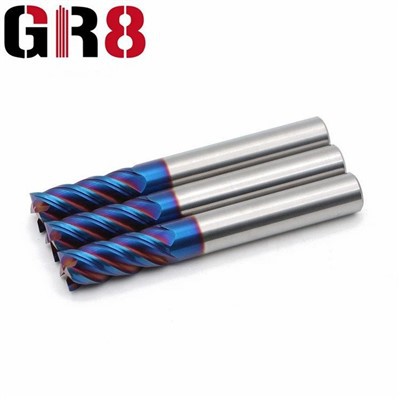
Balancing a 3 Flutes Roughing End Mill is crucial for optimal performance in machining operations. As a supplier of [hyperlink text="3 Flutes Roughing End Mill" url="/roughing-end-mill/3-flutes-roughing-end-mill.html"], I've seen firsthand how proper balance can make or break a project. In this blog, I'll share some tips on how to achieve that perfect balance.
Why Balancing Matters
First off, let's talk about why balancing a 3 Flutes Roughing End Mill is so important. When an end mill isn't balanced correctly, it can cause a whole bunch of problems. Vibration is one of the biggest issues. Excessive vibration leads to premature wear and tear on the tool, reducing its lifespan significantly. It also affects the quality of the cut. You end up with a rougher surface finish on your workpiece, which means more time and effort spent on finishing operations.
Moreover, unbalanced end mills put extra stress on the spindle of the machine. This can lead to spindle damage over time, which is an expensive repair. So, by balancing your end mill, you're not only saving money on tool replacement but also avoiding costly machine repairs.
Understanding Imbalance
Before we dive into the balancing process, it's essential to understand what causes imbalance in a 3 Flutes Roughing End Mill. There are two main types of imbalance: static and dynamic.
Static imbalance occurs when the center of gravity of the end mill doesn't coincide with the axis of rotation. This can be due to uneven material distribution in the tool, such as variations in the density of the carbide or uneven flute geometry. You can think of it like a tire on a car that's heavier on one side. When it spins, it causes a wobbling effect.
Dynamic imbalance is a bit more complex. It happens when the end mill has a force couple, which means there are two opposite forces acting at different points along the axis of rotation. This type of imbalance can cause the end mill to vibrate in a way that's not easily detectable by just looking at it. It often requires specialized equipment to measure and correct.
Measuring Imbalance
To balance a 3 Flutes Roughing End Mill, you first need to measure the amount of imbalance. There are a few different tools you can use for this. One common option is a balancing machine. These machines can accurately measure both static and dynamic imbalance. They work by spinning the end mill at a high speed and using sensors to detect any vibrations. The machine then calculates the amount and location of the imbalance.
Another option is a simple static balancer. This is a device that allows you to place the end mill on a horizontal shaft and see which way it tends to rotate. If it always rotates to one side, it means there's a static imbalance. While static balancers are less accurate than balancing machines, they can still give you a good idea of whether your end mill needs balancing.
Correcting Imbalance
Once you've measured the imbalance, it's time to correct it. There are a couple of different methods you can use.


The most common method is adding or removing material from the end mill. If there's a heavy spot on the end mill, you can remove a small amount of material from that area using a grinding wheel. Conversely, if there's a light spot, you can add a small counterweight. This could be in the form of a small piece of metal that's attached to the end mill.
Another method is using balancing rings. These are rings that can be adjusted to change the distribution of weight around the end mill. You simply place the balancing ring on the end mill and adjust it until the end mill is balanced. This method is quick and easy, but it may not be as precise as adding or removing material.
Tips for Balancing
Here are some additional tips to help you balance your 3 Flutes Roughing End Mill effectively:
- Keep it clean: Make sure the end mill is clean before you start the balancing process. Any dirt or debris on the end mill can affect the balance readings.
- Check the mounting: Ensure that the end mill is properly mounted in the balancing machine or static balancer. A loose or misaligned end mill will give inaccurate readings.
- Recheck the balance: After making any adjustments, recheck the balance of the end mill. It's possible that the initial adjustment may not have been enough, or it may have created a new imbalance.
Working with a Supplier
As a [hyperlink text="3 Flutes Roughing End Mill" url="/roughing-end-mill/3-flutes-roughing-end-mill-1.html"] supplier, we understand the importance of providing balanced tools. We take extra care during the manufacturing process to ensure that our end mills are as balanced as possible. However, we also know that even the best-manufactured end mills may need some fine-tuning.
If you're having trouble balancing your end mill, don't hesitate to reach out to us. We have a team of experts who can provide you with more detailed advice and assistance. We can also offer [hyperlink text="3 Flutes Roughing Milling Cutter" url="/roughing-end-mill/3-flutes-roughing-milling-cutter-1.html"] that are pre-balanced to meet your specific requirements.
Conclusion
Balancing a 3 Flutes Roughing End Mill is a crucial step in ensuring the success of your machining operations. By understanding the causes of imbalance, using the right tools to measure it, and applying the appropriate correction methods, you can extend the lifespan of your end mill, improve the quality of your cuts, and reduce the risk of machine damage.
If you're in the market for high-quality [hyperlink text="3 Flutes Roughing End Mill" url="/roughing-end-mill/3-flutes-roughing-end-mill.html"] or need help with balancing, feel free to get in touch. We'd love to discuss your needs and how we can partner with you to achieve the best results in your machining projects.
References
- Smith, J. (2020). Machining Handbook. Publisher Name.
- Brown, A. (2019). Tool Balancing: Principles and Practices. Journal of Manufacturing Technology, 15(2), 45-52.