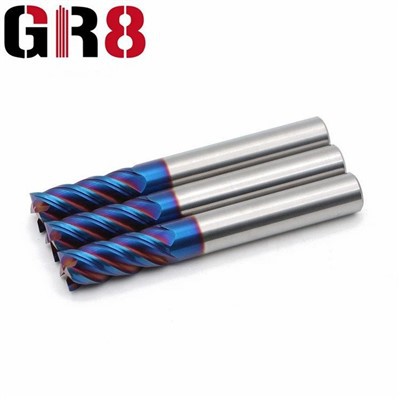
Calculating the feed per tooth for a ball nose end mill is a crucial aspect in machining operations. As a supplier of high - quality ball nose end mills, I understand the significance of getting this calculation right to achieve optimal performance and precision in various machining tasks.
Understanding the Basics of Feed per Tooth
The feed per tooth (FPT), also known as chip load per tooth, refers to the distance the cutter advances into the workpiece during each revolution of the cutter for each cutting edge. This parameter has a direct impact on the surface finish, tool life, and the overall machining efficiency.
A proper feed per tooth ensures that the cutting forces are evenly distributed across the cutting edge. If the feed per tooth is too high, the cutting edge may experience excessive wear, leading to premature tool failure and poor surface finish. On the other hand, if the feed per tooth is too low, it will result in lower machining efficiency as more time will be required to complete the job.
Factors Affecting Feed per Tooth
When calculating the feed per tooth for a ball nose end mill, several factors need to be taken into consideration:
Workpiece Material
The type of material being machined is one of the most critical factors. Different materials have different hardness, toughness, and machinability. For example, soft materials like aluminum can generally tolerate a higher feed per tooth compared to hard materials such as stainless steel or titanium. The cutting behavior of the material, such as its tendency to form chips, also influences the feed per tooth. Materials that produce long chips may require a lower feed per tooth to prevent chip clogging in the flutes of the end mill.
Tool Geometry
The design of the ball nose end mill itself plays a significant role. The number of flutes is an important aspect. A 4 Flutes Ball Nose End Mill can handle a different feed per tooth compared to a 2 Flutes Ball Nose End Mill or 2 Flutes Ball Nose End Mill. A ball nose end mill with more flutes can provide a smoother surface finish but may require a lower feed per tooth to avoid excessive cutting forces. The diameter of the end mill also affects the feed per tooth. Larger diameter end mills can generally handle a higher feed per tooth as they have more cutting edge area.
Machining Conditions
The speed of the spindle, depth of cut, and width of cut all impact the feed per tooth. A higher spindle speed may allow for a higher feed per tooth, but this is also limited by the material and tool capabilities. A deeper or wider cut will usually require a lower feed per tooth to maintain stable cutting conditions and prevent the tool from overloading.
Calculation Methods
General Formula
The basic formula for calculating the feed per tooth is:
[FPT=\frac{FR}{N\times S}]
where:
- (FPT) is the feed per tooth (in inches per tooth or millimeters per tooth)
- (FR) is the feed rate (in inches per minute or millimeters per minute)
- (N) is the number of teeth on the end mill
- (S) is the spindle speed (in revolutions per minute, RPM)
For example, if we have a feed rate (FR = 10) inches per minute, a ball nose end mill with (N = 4) teeth, and a spindle speed (S= 2000) RPM. Using the formula above, we can calculate the feed per tooth:
[FPT=\frac{10}{4\times2000}= 0.00125] inches per tooth
Using Machining Handbooks
Machining handbooks are valuable resources that provide recommended feed per tooth values based on the workpiece material, tool geometry, and machining conditions. These values are often the result of extensive testing and research. For instance, if you are machining mild steel with a 6 - millimeter diameter, 4 - flute ball nose end mill at a spindle speed of 3000 RPM, the machining handbook might suggest a feed per tooth in the range of 0.02 - 0.05 millimeters per tooth.
Software and Online Calculators
In modern machining, there are also many software programs and online calculators available. These tools take into account multiple factors simultaneously and can provide more accurate feed per tooth values. You simply input parameters such as workpiece material, tool geometry, and machining conditions, and the software or calculator will generate the appropriate feed per tooth value.
Practical Tips for Setting Feed per Tooth
Start with Conservative Values
When you are unsure about the appropriate feed per tooth, it is always a good idea to start with a conservative value. You can then gradually increase the feed per tooth while monitoring the cutting process. Look for signs such as excessive tool wear, poor surface finish, or abnormal cutting noises. If any of these issues occur, reduce the feed per tooth.
Consider the Entire Machining Process
Remember that the feed per tooth is just one part of the entire machining process. It should be coordinated with other parameters such as spindle speed, depth of cut, and width of cut. For example, if you increase the feed per tooth, you may need to adjust the spindle speed or depth of cut to maintain a stable and efficient machining process.
Tool Inspection
Regularly inspect the ball nose end mill during the machining process. Examine the cutting edges for signs of wear, chipping, or breakage. If significant wear is detected, adjust the feed per tooth or replace the tool as needed. This will help ensure consistent performance and high - quality machining results.
Conclusion
Calculating the feed per tooth for a ball nose end mill is a complex but essential task in machining. By understanding the factors that affect feed per tooth, using appropriate calculation methods, and following practical tips, you can optimize your machining process, improve tool life, and achieve better surface finishes.
As a supplier of ball nose end mills, we are committed to providing you with high - quality products and the technical support you need to succeed in your machining operations. If you have any questions about choosing the right ball nose end mill or calculating the appropriate feed per tooth, we are here to help. Please feel free to reach out to us to discuss your specific requirements and start a procurement negotiation for our top - notch ball nose end mills.


References
- "Machining Fundamentals", Industrial Press, Inc.
- "Handbook of Machining with Cutting Tools", CRC Press