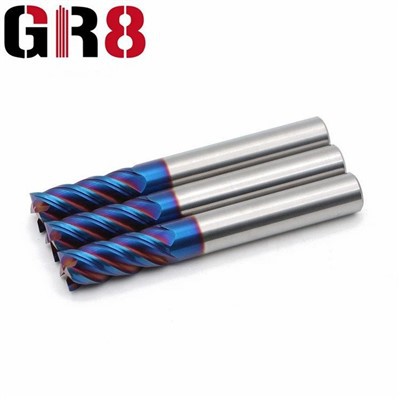
Flute design is a crucial aspect of square end mills, significantly influencing their performance in various machining operations. As a leading supplier of square end mills, we understand the importance of a well - designed flute and how it can enhance the efficiency and quality of machining processes.
The Basics of Flute Design in Square End Mills
A square end mill is a type of milling cutter with a flat end, commonly used for facing, slotting, profiling, and other machining tasks. The flutes are the spiral grooves cut into the body of the end mill. These flutes serve multiple important functions, including chip evacuation, cutting edge formation, and coolant flow.
The number of flutes on a square end mill is one of the most fundamental design features. A higher number of flutes generally allows for a higher feed rate because there are more cutting edges engaged with the workpiece at any given time. For example, 65HRC 4 Flutes Flat End Mill offers a good balance between chip - handling capacity and cutting speed. With four flutes, it can remove material relatively quickly while maintaining a reasonable amount of space for chips to escape.
On the other hand, end mills with fewer flutes, such as the 2 Flutes Flat End Mill, are often preferred when machining soft materials or when dealing with deep cuts. The larger flute space in a two - flute end mill provides better chip evacuation, reducing the risk of chip jamming and tool breakage. This is especially important in applications where long chips are produced, as they need to be removed from the cutting area efficiently.
Helix Angle and Flute Design
The helix angle of the flutes also plays a vital role in the performance of square end mills. The helix angle is the angle between the flute's spiral path and the axis of the end mill. A higher helix angle typically results in a smoother cutting action, as it allows the chips to be more easily transported up the flutes and out of the cutting zone.
In general, a high helix angle (e.g., 45 degrees or more) is suitable for machining materials that tend to produce long, stringy chips, such as aluminum and some plastics. The increased rake angle provided by the high helix helps to shear the material more effectively, reducing cutting forces and improving surface finish. However, high - helix end mills may have lower radial strength compared to those with lower helix angles, which can limit their use in applications where high radial forces are encountered.
Conversely, a lower helix angle (e.g., 30 degrees) is often used for machining harder materials like steel. The lower helix provides greater edge strength, making the end mill more resistant to chipping and wear. It also allows for better control of the cutting forces, which is crucial when working with tough materials.
Chip Evacuation and Flute Design
One of the primary functions of the flutes is to evacuate chips from the cutting area. Proper chip evacuation is essential for preventing chip re - cutting, which can lead to poor surface finish, increased tool wear, and even tool breakage.
The shape and size of the flutes are designed to optimize chip evacuation. A well - designed flute should have enough space to accommodate the chips without overcrowding. In addition, the flute's surface should be smooth to minimize friction and allow the chips to flow freely.
For example, some advanced flute designs incorporate variable helix and variable pitch. Variable helix means that the helix angle changes along the length of the end mill, while variable pitch refers to the variation in the distance between adjacent flutes. These designs can disrupt the formation of uniform chips, preventing them from packing together and improving chip evacuation.


Cutting Performance and Flute Design
The flute design directly affects the cutting performance of square end mills. The number of flutes, helix angle, and chip - evacuation properties all contribute to the overall cutting efficiency.
In high - speed machining applications, end mills with a large number of flutes and a high helix angle are often preferred. These designs allow for high feed rates and smooth cutting, reducing cycle times and improving productivity. However, it is important to match the end - mill design to the specific machining conditions, including the material being machined, the depth of cut, and the available spindle power.
When machining difficult - to - cut materials, such as titanium or nickel - based alloys, special flute designs may be required. These materials generate high cutting forces and produce chips that are difficult to break and evacuate. End mills with a large flute space, a low helix angle, and a strong cutting edge are often used to handle these challenging materials.
Specialized Flute Designs for Specific Applications
In addition to the standard flute designs, there are also specialized flute designs for specific applications. For example, the Ogee Door Frame Bit Set is designed with a unique flute geometry to create the intricate profiles required for ogee door frames. These bits often have a combination of different flute shapes and cutting edges to achieve the desired finish.
Another example is the flute design for finishing operations. Finishing end mills typically have a large number of flutes with a very fine pitch, which allows for a smooth surface finish and precise machining. These end mills are often used in the final stages of a machining process to achieve the required surface quality and dimensional accuracy.
Conclusion
As a square end mill supplier, we recognize that the flute design is a critical factor in the performance of our products. By understanding the different aspects of flute design, including the number of flutes, helix angle, chip - evacuation properties, and specialized designs for specific applications, we can provide our customers with the right end mills for their machining needs.
Whether you are machining soft materials like wood or plastic, or hard materials like steel or titanium, we have a wide range of square end mills with different flute designs to meet your requirements. If you are interested in learning more about our products or have specific machining challenges that you need to address, we encourage you to contact us for a detailed discussion. Our team of experts is always ready to help you select the most suitable end mills for your application and provide you with professional advice on machining processes. Let's work together to achieve the best results in your machining operations.
References
- Groover, M. P. (2010). Fundamentals of Modern Manufacturing: Materials, Processes, and Systems. Wiley.
- Kalpakjian, S., & Schmid, S. R. (2009). Manufacturing Engineering and Technology. Pearson Prentice Hall.