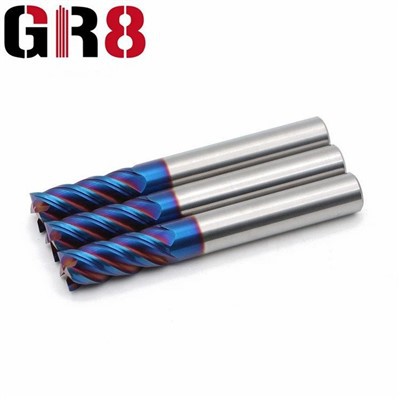
What is the flute twist direction of spiral flute bits?
As a supplier of Spiral Flute Bits, I often encounter questions from customers regarding the flute twist direction of these essential cutting tools. Understanding the flute twist direction is crucial as it significantly impacts the performance and application of spiral flute bits. In this blog post, I'll delve into the details of flute twist directions, their effects, and how to choose the right one for different machining needs.
Understanding Flute Twist Directions
Spiral flute bits typically come in two main flute twist directions: right - hand twist and left - hand twist.
A right - hand twist spiral flute bit is the most commonly used type. When you look at the tip of the bit, the flutes spiral in a clockwise direction from the tip towards the shank. This type of bit is designed to rotate in a counter - clockwise direction during operation. As the bit rotates counter - clockwise, the right - hand twist flutes work to pull the chips up and out of the cut. This is highly beneficial as it helps to prevent chip clogging, which can lead to overheating and poor cutting quality.
On the other hand, a left - hand twist spiral flute bit has flutes that spiral in a counter - clockwise direction from the tip towards the shank. It is intended to rotate in a clockwise direction. Left - hand twist bits are less common but have specific applications. They are often used in situations where you need to push the chips down into the cut or when dealing with special machining operations.
Effects of Flute Twist Direction on Machining
The choice of flute twist direction can have a profound impact on the machining process.
Chip Evacuation: As mentioned earlier, right - hand twist bits are excellent at pulling chips out of the cut when rotating counter - clockwise. This is especially important when drilling deep holes or working with materials that produce long, stringy chips. For example, when machining aluminum, a right - hand twist bit will efficiently remove the chips, reducing the risk of chip recutting and improving the surface finish of the hole.
In contrast, left - hand twist bits push chips down into the cut. This can be useful in some scenarios, such as when you want to keep the chips contained within a cavity or when working with materials that tend to break into small chips.
Cutting Forces: The flute twist direction also affects the cutting forces acting on the bit. Right - hand twist bits, when used correctly, generate forces that help to keep the bit stable during cutting. The upward chip evacuation also reduces the downward pressure on the bit, minimizing the chance of the bit wandering or breaking.
Left - hand twist bits can generate different force patterns. They may be more suitable for applications where you need to counteract certain forces, such as when using a lathe and processing parts in a specific orientation.
Surface Finish: The way chips are removed from the cut directly impacts the surface finish of the machined part. Right - hand twist bits, with their efficient chip evacuation, generally result in a smoother surface finish. The chips are quickly removed, preventing them from scratching or marring the surface of the workpiece.
Applications of Different Flute Twist Directions
Right - Hand Twist Bits:


- General Drilling: In most general drilling applications, right - hand twist bits are the go - to choice. Whether you are drilling holes in wood, metal, or plastic, a right - hand twist bit will provide reliable performance. For instance, in woodworking, a right - hand twist bit can quickly and cleanly drill holes for dowels or screws.
- CNC Machining: In CNC milling and drilling operations, right - hand twist bits are widely used. They are compatible with the standard counter - clockwise rotation of most CNC spindles. You can find right - hand twist bits in various configurations, such as One Spiral Flute Bits, which are suitable for roughing operations, and 2 Flutes Ball Nose Bits, which are ideal for contouring and finishing.
Left - Hand Twist Bits:
- Thread Milling: Left - hand twist bits are often used in thread milling operations. When creating left - hand threads, a left - hand twist bit can help to push the chips down and out of the way, ensuring a clean and accurate thread.
- Specialty Machining: In some specialty machining operations, such as back - boring or internal grooving, left - hand twist bits can be the preferred choice. They can be used in combination with other tools to achieve specific machining goals.
Choosing the Right Flute Twist Direction
When selecting a spiral flute bit, you need to consider several factors to determine the appropriate flute twist direction.
Material: Different materials have different chip - forming characteristics. For materials like steel, which produce long, continuous chips, a right - hand twist bit is usually a good choice for efficient chip evacuation. For brittle materials like cast iron, which break into small chips, the flute twist direction may be less critical, but a right - hand twist bit can still provide better overall performance.
Machining Operation: The type of machining operation also plays a role. If you are drilling deep holes, a right - hand twist bit will help to keep the chips from clogging the hole. For operations where you need to push chips down, such as in some internal machining processes, a left - hand twist bit may be more appropriate.
Machine Compatibility: Make sure the flute twist direction is compatible with the rotation direction of your machine. Most standard drilling and milling machines rotate counter - clockwise, so right - hand twist bits are the natural choice. However, if you have a machine that can rotate clockwise, you may be able to take advantage of left - hand twist bits.
Our Spiral Flute Bit Offerings
As a supplier of Spiral Flute Bits, we offer a wide range of products with different flute twist directions to meet your diverse machining needs. Our One Spiral Flute Bits are designed for high - speed roughing operations, providing excellent chip evacuation and cutting performance. The right - hand twist design ensures efficient chip removal, making them suitable for a variety of materials.
Our 2 Flutes Ball Nose Bits are perfect for finishing and contouring operations. The two - flute design, combined with the right - hand twist, allows for smooth cutting and a high - quality surface finish.
We also have 2 Flutes Flat Bits, which are commonly used for drilling flat - bottomed holes. These bits are available in both right - hand and left - hand twist options, giving you the flexibility to choose the most suitable bit for your specific application.
Conclusion
In conclusion, the flute twist direction of spiral flute bits is a critical factor that affects the performance, chip evacuation, cutting forces, and surface finish of the machining process. Understanding the differences between right - hand and left - hand twist bits and their applications will help you make the right choice for your machining needs.
If you are interested in our Spiral Flute Bits or have any questions about flute twist directions, please feel free to contact us for a detailed discussion and to start a procurement negotiation. We are committed to providing you with high - quality cutting tools and excellent customer service.
References
- "Machining Handbook" by Eugene A. Avallone and Theodore Baumeister III.
- "Cutting Tool Engineering" magazine, various issues on spiral flute bit technology.