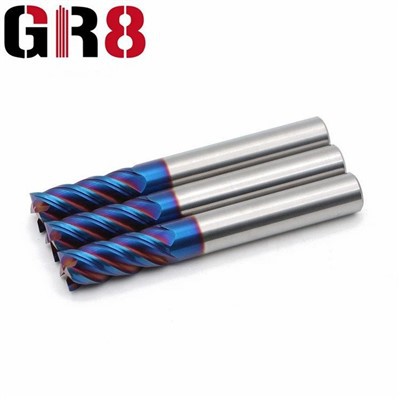
Hey there! As a supplier of Ball Nose End Mills, I often get asked about the power consumption of these nifty tools. So, let's dive right in and break it down.
First off, what's a ball nose end mill? Well, it's a cutting tool with a rounded end, kind of like a ball. These are super useful in machining operations, especially when you're looking to create curved or contoured surfaces. They're used in a wide range of industries, from aerospace to automotive, and even in custom jewelry making.
Now, the power consumption of a ball nose end mill isn't a one - size - fits - all deal. It depends on several factors. Let's start with the material being machined. Different materials have different hardness levels. For example, machining aluminum is a whole lot easier than machining titanium. Aluminum is a relatively soft metal, so it requires less cutting force. When you need less cutting force, the power consumption of the end mill is lower. On the other hand, titanium is extremely hard and tough. The end mill has to work much harder to cut through it, which means more power is needed.

The size of the ball nose end mill also plays a huge role. A larger diameter end mill generally needs more power. Why? Well, a bigger end mill has a larger cutting edge. When it's cutting, it's removing more material with each pass. This requires more force, and thus, more power. For instance, if you're using a 1 - inch diameter ball nose end mill compared to a 1/4 - inch diameter one, the 1 - inch one will consume more power because it's covering a larger area and taking out more material at once.
The number of flutes on the end mill is another important factor. We offer 2 Flutes Ball Nose End Mill and 4 Flutes Ball Nose End Mill. A 2 - flute end mill is great for roughing operations. It can remove material quickly, but it might not give you the smoothest finish. Since it has fewer flutes, there's less contact with the material at any given time. This usually means it requires less power compared to a 4 - flute end mill.
A 4 - flute end mill, on the other hand, is better for finishing operations. It gives a much smoother surface finish. But because it has more flutes in contact with the material simultaneously, it needs more power to rotate and cut through the workpiece. So, if you're in a situation where power consumption is a major concern and you're doing rough machining, a 2 Flutes Ball Nose End Mill might be your best bet.
The cutting speed and feed rate also impact power consumption. Cutting speed refers to how fast the end mill rotates, and feed rate is how fast the workpiece moves towards the end mill. If you increase the cutting speed, the end mill will cut through the material faster. However, this also means it has to work harder, and power consumption goes up. Similarly, a higher feed rate means more material is being removed per unit of time, which also requires more power.
Let's talk about the machine itself. The type of CNC machine or milling machine you're using can affect power consumption. Older machines might not be as energy - efficient as newer ones. Newer machines often come with advanced control systems that can optimize the cutting process. They can adjust the cutting speed and feed rate based on the material and the end mill being used. This can lead to more efficient power usage.
Now, how can you calculate the power consumption of a ball nose end mill? Well, there's no simple formula that works for every situation. But there are some general guidelines. You can start by looking at the power rating of your machine. The power rating tells you how much power the machine can consume at its maximum. Then, you need to consider the cutting parameters I mentioned earlier.
For example, if you know the cutting force required for a particular material and the size of the end mill, you can estimate the power needed. Cutting force can be measured using specialized sensors, but in a more practical setting, you can refer to machining handbooks that provide typical cutting force values for different materials and end mill sizes.
Let's say you're machining a block of steel with a 3/8 - inch diameter 4 - flute ball nose end mill. The cutting force for steel is relatively high. If you set a high cutting speed and feed rate, the end mill will need more power to cut through the steel. You can use the power rating of your machine as a reference. If your machine has a power rating of 5 horsepower and you know that the cutting process requires a significant amount of that power, you can adjust your cutting parameters to stay within a reasonable power consumption range.
In addition to power consumption, you also need to think about the efficiency of the cutting process. An efficient cutting process not only saves power but also reduces tool wear. If you're using the wrong cutting parameters, the end mill might wear out quickly. This means you'll have to replace it more often, which can be costly.

So, how do you find the right balance? It takes a bit of experimentation. Start by using the recommended cutting parameters provided by the end mill manufacturer. These parameters are usually based on extensive testing and are a good starting point. Then, you can make small adjustments based on your specific machining requirements.

If you're looking to reduce power consumption, here are some tips. First, use the right end mill for the job. As I mentioned earlier, a 2 - flute end mill is better for roughing when power is a concern. Second, optimize your cutting speed and feed rate. Don't go too fast or too slow. Find the sweet spot where you can get good material removal rates without using excessive power. Third, keep your machine well - maintained. A machine that's in good condition will operate more efficiently.
As a supplier of ball nose end mills, I understand the importance of power consumption for our customers. We're always here to help you choose the right end mill for your specific needs. Whether you're looking for a 2 Flutes Ball Nose End Mill for roughing or a 4 Flutes Ball Nose End Mill for finishing, we've got you covered.

If you're interested in learning more about our products or have questions about power consumption and machining, don't hesitate to reach out. We'd love to have a chat with you and discuss how we can meet your requirements. Whether you're a small - scale workshop or a large - scale manufacturing plant, we can provide you with high - quality ball nose end mills that offer great performance and efficiency.
References
- Machining Handbook, Industrial Press Inc.
- Cutting Tool Technology: Principles and Applications, CRC Press