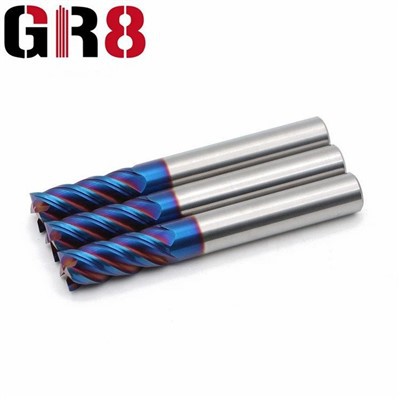
When working with precision machining and CNC operations, the cutting strategy employed can significantly impact the quality, efficiency, and cost of production. As a supplier of 2 Flutes Ball Nose Bits, I've witnessed firsthand how the right cutting approach can transform the end - result of a project. In this blog post, I'll discuss the recommended cutting strategies for 2 Flutes Ball Nose Bits, exploring different elements such as speed, feed, depth of cut, and tool path.


Understanding 2 Flutes Ball Nose Bits
Before diving into the cutting strategies, it's essential to understand the nature of 2 Flutes Ball Nose Bits. These bits are characterized by their two cutting edges and a hemispherical tip. The design allows for smoother surface finishes and makes them ideal for 3D contouring, profiling, and side milling applications. Compared to One Spiral Flute Bits, 2 Flutes Ball Nose Bits offer higher material removal rates while maintaining precision. In contrast to 2 Flutes Flat Bits, they can create rounded edges and complex geometries with ease.
Optimizing Cutting Speed
Cutting speed, often measured in surface feet per minute (SFM), refers to how fast the cutting edge of the tool moves against the workpiece. For 2 Flutes Ball Nose Bits, finding the right cutting speed is crucial. If the speed is too slow, it can lead to excessive tool wear, as the tool spends more time in contact with the material. On the other hand, if the speed is too fast, the tool may generate excessive heat, which can cause the cutting edges to lose their hardness and also result in a poor surface finish.
The optimal cutting speed depends on several factors, including the material of the workpiece and the material of the tool. For common materials like aluminum, a cutting speed in the range of 500 - 1500 SFM is generally appropriate for 2 Flutes Ball Nose Bits made of high - speed steel (HSS). When working with more rigid materials such as stainless steel, the speed should be reduced to around 100 - 300 SFM. Carbide - tipped 2 Flutes Ball Nose Bits can handle higher cutting speeds, with SFM values reaching up to 2000 for aluminum and 500 for stainless steel.
It's also important to note that as the diameter of the 2 Flutes Ball Nose Bit increases, the cutting speed should be adjusted accordingly. Larger - diameter bits require lower rotational speeds to maintain the same surface speed.
Feed Rate Considerations
The feed rate is the speed at which the workpiece moves relative to the cutting tool. It is typically measured in inches per minute (IPM). A proper feed rate is essential for efficient material removal and to prevent tool breakage. When using 2 Flutes Ball Nose Bits, a higher feed rate can increase productivity, but only within the limits of the tool and the material.
The feed rate is directly related to the number of flutes on the tool. With 2 Flutes Ball Nose Bits, the feed per tooth (FPT) is an important parameter. FPT is the distance the tool advances for each flute's rotation. For general milling operations, a FPT of around 0.002 - 0.005 inches per tooth is a good starting point when working with aluminum. When machining harder materials, such as titanium or hardened steel, the FPT should be reduced to 0.001 - 0.003 inches per tooth.
It's crucial to balance the feed rate with the cutting speed. A low feed rate combined with a high cutting speed can cause built - up edge, where small pieces of the workpiece material adhere to the cutting edge. This can degrade the surface finish and increase tool wear.
Depth of Cut
The depth of cut refers to how far the tool penetrates into the workpiece during each pass. There are two types of depth of cut: axial (along the tool's axis) and radial (in the perpendicular direction to the tool's axis).
For 2 Flutes Ball Nose Bits, a general rule of thumb is to keep the axial depth of cut relatively shallow, typically around 0.01 - 0.05 inches, depending on the material and the tool diameter. A larger axial depth of cut can put excessive stress on the tool, leading to breakage or rapid wear.
The radial depth of cut should also be carefully controlled. When roughing, a radial depth of cut of up to 20 - 30% of the tool diameter can be used to quickly remove material. However, when finishing, the radial depth of cut should be reduced to 0.002 - 0.01 inches to achieve a smooth surface finish.
Tool Path Strategies
The tool path determines how the 2 Flutes Ball Nose Bit moves across the workpiece. There are several common tool path strategies, each with its own advantages.
Conventional Milling
In conventional milling, the cutting force acts in the opposite direction of the tool's rotation. This type of milling can be effective for roughing operations, as it tends to push the chips away from the cutting zone. However, it can also cause more vibration and wear on the tool.
Climb Milling
Climb milling, on the other hand, has the cutting force acting in the same direction as the tool's rotation. This results in a cleaner cut, less vibration, and reduced tool wear. It is often the preferred method for finishing operations with 2 Flutes Ball Nose Bits.
Zig - Zag Tool Path
The zig - zag tool path is efficient for roughing large areas. It involves moving the tool back and forth in a parallel pattern across the workpiece. This allows for rapid material removal, but it may leave a stepped surface that requires finishing passes.
Spiral Tool Path
A spiral tool path is beneficial for creating smooth, continuous cuts, especially when machining 3D contours. The tool moves in a spiral pattern, either in a downward or upward direction, depending on the application. This strategy can minimize tool marks and provide a high - quality surface finish.
Chip Management
Effective chip management is essential when using 2 Flutes Ball Nose Bits. If chips are not properly removed from the cutting zone, they can cause re - cutting, which leads to poor surface finish and increased tool wear.
There are several ways to manage chips. One common method is to use coolant or lubricant. Coolant helps to reduce heat, lubricate the cutting edge, and wash away chips. It is particularly important when machining materials that generate long, stringy chips, such as aluminum.
Using the correct cutting speed and feed rate also plays a role in chip management. A well - optimized cutting process will produce chips that are small and easy to evacuate. Additionally, ensuring proper clearance in the tool path and machine setup can prevent chips from accumulating around the tool.
Safety Precautions
When implementing these cutting strategies, safety should always be a top priority. Operators should wear appropriate personal protective equipment (PPE), including safety glasses, gloves, and hearing protection. Ensuring the machine is properly maintained and calibrated is also crucial to prevent accidents. Before starting any cutting operation, the operator should thoroughly review the machine's manual and follow all safety guidelines.
Contact for Procurement
If you're interested in enhancing your machining operations with high - quality 2 Flutes Ball Nose Bits, I encourage you to reach out to discuss your specific requirements. Our team of experts is ready to assist you in choosing the right tools and sharing further insights on cutting strategies to optimize your production processes.
References
- Cox, John. "Advanced Milling Techniques." Machining Journal, Vol. 12, Issue 3, 2020.
- Smith, David. "Tool Selection and Cutting Parameters for CNC Machining." Manufacturing Review, Vol. 15, Issue 1, 2019.