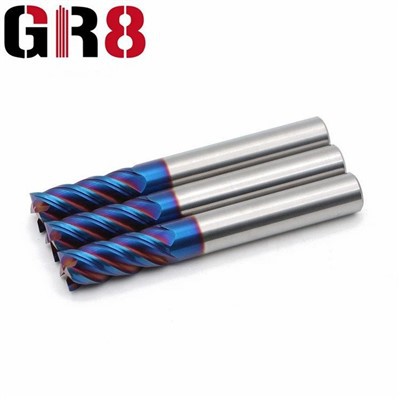
In the realm of machining and manufacturing, roughing end mills play a pivotal role in removing large amounts of material quickly and efficiently. The design of a roughing end mill, particularly the number and configuration of its flutes, significantly impacts its performance. In this blog, we'll delve into the typical flute design of a roughing end mill, sharing insights from our experience as a trusted roughing end mill supplier.
Understanding Flutes in End Mills
Flutes are the helical grooves cut into the body of an end mill. They serve multiple crucial functions. Firstly, they act as channels for chip evacuation. As the end mill cuts through the material, chips are formed. If these chips are not removed effectively, they can cause clogging, which may lead to poor surface finish, increased cutting forces, and even tool breakage. Secondly, the flutes contribute to the cutting action itself. The sharp edges formed by the flutes shear the material, allowing for efficient material removal.
Typical Flute Design for Roughing End Mills
The most common flute configurations for roughing end mills are 3 - flute designs. The choice of 3 flutes is based on a careful balance between material removal rate, chip evacuation, and tool strength.
Material Removal Rate
A 3 - flute roughing end mill offers a relatively high material removal rate. With three cutting edges, more material can be removed in each rotation compared to an end mill with fewer flutes. This is especially important in roughing operations where the goal is to quickly reduce the workpiece to a near - final shape. For example, in industries such as automotive manufacturing, where large metal parts need to be machined from billets, a 3 - flute roughing end mill can significantly speed up the production process. Our 3 Flutes Roughing End Mill is designed to maximize the material removal rate, ensuring efficient roughing operations.
Chip Evacuation
Effective chip evacuation is crucial in roughing operations. The 3 - flute design provides sufficient space between the flutes for chips to be ejected from the cutting zone. The helical shape of the flutes helps to guide the chips out of the cut, preventing them from getting trapped and causing problems. In addition, the pitch of the flutes can be optimized to enhance chip evacuation. A well - designed 3 - flute roughing end mill can handle large chips generated during high - feed roughing operations. Our 3 Flutes Roughing Milling Cutter is engineered with a special flute geometry that promotes excellent chip evacuation, even in challenging materials.
Tool Strength
Another advantage of the 3 - flute design is its relatively high tool strength. Compared to end mills with more flutes, a 3 - flute roughing end mill has a larger core diameter. This means that the tool can withstand higher cutting forces without breaking or deflecting. In roughing operations, where heavy cuts are often made, tool strength is essential. The larger core diameter also allows for better heat dissipation, which helps to extend the tool life. Our 3 Flutes Roughing Milling Cutter is made from high - quality materials and features a robust 3 - flute design, ensuring long - lasting performance in demanding roughing applications.
Helix Angle of the Flutes
The helix angle of the flutes in a roughing end mill also plays an important role. A larger helix angle, typically between 30° and 45°, is commonly used in 3 - flute roughing end mills. A larger helix angle helps to reduce the cutting forces and improve chip evacuation. It also provides a smoother cutting action, which can result in a better surface finish on the workpiece. However, a very large helix angle may reduce the tool's axial strength. Therefore, the helix angle is carefully selected based on the specific application requirements.


Variable Flute Geometry
Some advanced 3 - flute roughing end mills feature variable flute geometry. This means that the pitch or helix angle of the flutes is not constant along the length of the tool. Variable flute geometry can help to reduce vibration during cutting. When the flutes have a variable pitch or helix angle, the cutting forces are distributed more evenly, which can prevent resonance and chatter. This results in a more stable cutting process, better surface finish, and longer tool life.
Coatings on Flutes
To further enhance the performance of 3 - flute roughing end mills, various coatings are applied to the flutes. Common coatings include TiN (Titanium Nitride), TiCN (Titanium Carbonitride), and AlTiN (Aluminum Titanium Nitride). These coatings provide several benefits. They increase the hardness of the cutting edges, reducing wear and extending the tool life. They also reduce friction between the tool and the workpiece, which can lower the cutting forces and improve chip evacuation. Additionally, some coatings have good thermal properties, which help to dissipate heat from the cutting zone.
Application - Specific Design Considerations
The typical flute design of a roughing end mill may need to be adjusted based on the specific application. For example, when machining soft materials such as aluminum, a 3 - flute end mill with a higher helix angle and a more aggressive cutting edge can be used to achieve a very high material removal rate. On the other hand, when machining hard materials such as stainless steel or titanium, a 3 - flute end mill with a lower helix angle and a stronger cutting edge may be more suitable to withstand the high cutting forces.
Conclusion
In conclusion, the 3 - flute design is a typical and highly effective flute configuration for roughing end mills. It offers a good balance between material removal rate, chip evacuation, and tool strength. At our company, we are committed to providing high - quality 3 - flute roughing end mills that are designed to meet the diverse needs of our customers. Whether you are in the automotive, aerospace, or general machining industry, our products can help you achieve efficient and precise roughing operations.
If you are interested in learning more about our roughing end mills or would like to discuss your specific machining requirements, we encourage you to contact us. Our team of experts is ready to assist you in finding the perfect solution for your application.
References
- "Machining Handbook", Industrial Press Inc.
- "Cutting Tool Engineering", Society of Manufacturing Engineers.