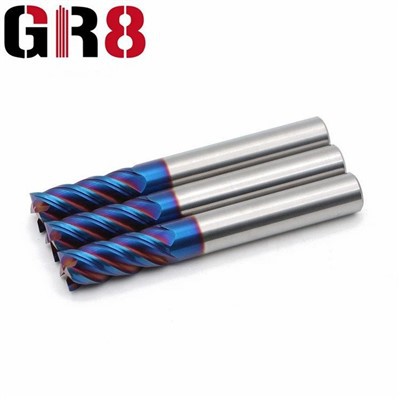
As a supplier of Corn End Mills, I often encounter inquiries from customers about the versatility of our products. One of the most common questions is whether a Corn End Mill can be used for milling hardened steel. In this blog post, I will delve into this topic, exploring the technical aspects, limitations, and potential applications of using a Corn End Mill on hardened steel.
Understanding Corn End Mills
Before we discuss the suitability of Corn End Mills for hardened steel, let's first understand what a Corn End Mill is. A Corn End Mill is a type of cutting tool used in milling operations. It features a rounded corner at the tip, which allows for smooth transitions between surfaces and reduces the risk of chipping or breaking the workpiece. This design makes it ideal for a variety of applications, including contouring, profiling, and slotting.
Corn End Mills are typically made from high-speed steel (HSS) or carbide. Carbide Corn End Mills are more popular due to their superior hardness, wear resistance, and ability to maintain sharp cutting edges at high temperatures. They are commonly used in industries such as aerospace, automotive, and mold making, where precision and efficiency are crucial.
Hardened Steel: A Challenging Material
Hardened steel is a type of steel that has been heat-treated to increase its hardness and strength. This process involves heating the steel to a specific temperature and then rapidly cooling it, which results in a fine-grained microstructure that is more resistant to wear and deformation. Hardened steel is commonly used in applications where high strength and durability are required, such as tooling, machinery components, and automotive parts.
However, the hardness of hardened steel also makes it a challenging material to machine. It has a high resistance to cutting forces, which can cause excessive wear on cutting tools and reduce their lifespan. Additionally, the heat generated during the cutting process can cause the steel to become even harder, further exacerbating the machining difficulties.
Can a Corn End Mill be Used for Milling Hardened Steel?
The answer to this question is not a simple yes or no. While a Corn End Mill can technically be used for milling hardened steel, there are several factors that need to be considered before attempting such an operation.
Tool Material
As mentioned earlier, the tool material plays a crucial role in determining the suitability of a Corn End Mill for milling hardened steel. Carbide Corn End Mills are generally preferred over HSS ones due to their superior hardness and wear resistance. However, not all carbide grades are created equal. For milling hardened steel, it is recommended to use a carbide grade that is specifically designed for high-hardness materials, such as a micro-grain carbide or a coated carbide.
Cutting Parameters
The cutting parameters, including the cutting speed, feed rate, and depth of cut, also need to be carefully selected to ensure successful milling of hardened steel. These parameters should be adjusted based on the hardness of the steel, the type of Corn End Mill being used, and the machine tool's capabilities. In general, lower cutting speeds and feed rates are recommended when milling hardened steel to reduce the cutting forces and prevent tool wear.
Coolant and Lubrication
Proper coolant and lubrication are essential when milling hardened steel. The heat generated during the cutting process can cause the tool to overheat and wear out quickly. Using a coolant or lubricant can help to dissipate the heat, reduce friction, and improve the surface finish of the workpiece. Water-soluble coolants are commonly used for milling hardened steel, as they provide good cooling and lubrication properties.
Machine Tool Rigidity
The rigidity of the machine tool is another important factor to consider when milling hardened steel. The high cutting forces generated during the process can cause the machine tool to vibrate, which can lead to poor surface finish, tool breakage, and inaccurate machining. Therefore, it is recommended to use a machine tool that is rigid and stable, with a high spindle power and torque.
Advantages of Using a Corn End Mill for Milling Hardened Steel
Despite the challenges associated with milling hardened steel, there are several advantages to using a Corn End Mill for this application.
Rounded Corners
The rounded corners of a Corn End Mill allow for smooth transitions between surfaces, which can help to reduce the stress concentration and prevent cracking or chipping of the workpiece. This is particularly important when milling hardened steel, which is more prone to cracking due to its high hardness.


Versatility
A Corn End Mill can be used for a variety of milling operations, including contouring, profiling, and slotting. This makes it a versatile tool that can be used in different applications, reducing the need for multiple cutting tools.
Precision
Corn End Mills are designed to provide high precision and accuracy in machining operations. They can produce smooth and accurate surfaces, which is essential for applications where tight tolerances are required.
Limitations of Using a Corn End Mill for Milling Hardened Steel
While there are advantages to using a Corn End Mill for milling hardened steel, there are also some limitations that need to be considered.
Tool Wear
Milling hardened steel can cause excessive wear on cutting tools, including Corn End Mills. The high hardness of the steel can quickly dull the cutting edges, reducing the tool's effectiveness and lifespan. This means that frequent tool changes may be required, which can increase the machining costs and downtime.
Machining Time
Due to the high resistance of hardened steel to cutting forces, the machining time for milling hardened steel is generally longer than for softer materials. This can reduce the productivity of the machining process and increase the overall manufacturing costs.
Surface Finish
Achieving a good surface finish when milling hardened steel can be challenging. The high cutting forces and heat generated during the process can cause the surface of the workpiece to become rough and uneven. This may require additional finishing operations, such as grinding or polishing, to achieve the desired surface quality.
Conclusion
In conclusion, while a Corn End Mill can be used for milling hardened steel, it is important to carefully consider the tool material, cutting parameters, coolant and lubrication, and machine tool rigidity before attempting such an operation. By selecting the right tool and optimizing the machining process, it is possible to achieve successful results and overcome the challenges associated with milling hardened steel.
If you are interested in purchasing Corn End Mills or have any questions about their suitability for your specific application, please feel free to contact us. Our team of experts is always ready to provide you with professional advice and support. We look forward to discussing your requirements and helping you find the best solutions for your machining needs.
References
- Tooling U-SME. (n.d.). Machining Hardened Steel. Retrieved from https://www.toolingu.com/
- Sandvik Coromant. (n.d.). Cutting Data for Milling Hardened Steel. Retrieved from https://www.sandvik.coromant.com/
- Kennametal. (n.d.). Milling Solutions for Hardened Steel. Retrieved from https://www.kennametal.com/