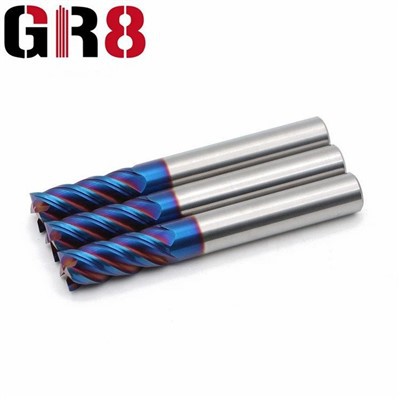
In the world of machining and manufacturing, the choice of cutting tools can significantly impact the quality and efficiency of the production process. One such tool that often sparks debate is the taper ball nose endmill. As a supplier of taper ball nose endmills, I am frequently asked whether these tools can be effectively used for finishing operations. In this blog post, I will delve into the characteristics of taper ball nose endmills, explore their suitability for finishing, and provide insights based on my experience in the industry.
Understanding Taper Ball Nose Endmills
Before we discuss the use of taper ball nose endmills for finishing, it's essential to understand what these tools are and how they differ from other endmills. A taper ball nose endmill is a cutting tool with a tapered shape and a ball-shaped tip. The taper allows for a gradual reduction in diameter along the length of the tool, while the ball nose provides a rounded cutting edge. This combination of features makes taper ball nose endmills versatile and suitable for a variety of machining applications, including profiling, contouring, and pocketing.
One of the key advantages of taper ball nose endmills is their ability to create smooth, curved surfaces. The ball nose design allows for a more gradual engagement with the workpiece, reducing the risk of chatter and producing a better surface finish compared to flat endmills. Additionally, the taper provides clearance between the tool and the workpiece, preventing interference and allowing for deeper cuts without sacrificing accuracy.
Suitability for Finishing Operations
Now, let's address the question at hand: Can a taper ball nose endmill be used for finishing? The answer is yes, but with some considerations. Taper ball nose endmills can be effectively used for finishing operations, especially when working with complex geometries or curved surfaces. The ball nose design allows for a smooth and continuous cutting motion, resulting in a high-quality surface finish.


However, it's important to note that the suitability of a taper ball nose endmill for finishing depends on several factors, including the material being machined, the desired surface finish, and the machining parameters. For example, when machining soft materials such as aluminum or plastics, a taper ball nose endmill can provide excellent results with minimal effort. The sharp cutting edge of the ball nose allows for clean cuts and a smooth surface finish, even at high feed rates.
On the other hand, when machining harder materials such as steel or titanium, the performance of a taper ball nose endmill may be limited. The increased hardness of the material can cause the cutting edge to wear more quickly, resulting in a decrease in surface finish quality. In these cases, it may be necessary to use a different type of endmill or to adjust the machining parameters to ensure optimal performance.
Another factor to consider when using a taper ball nose endmill for finishing is the depth of cut. While the taper provides clearance between the tool and the workpiece, excessive depth of cut can still cause chatter and vibration, resulting in a poor surface finish. It's important to carefully select the appropriate depth of cut based on the material being machined, the tool diameter, and the machining parameters.
Advantages of Using Taper Ball Nose Endmills for Finishing
Despite the limitations, there are several advantages to using taper ball nose endmills for finishing operations. One of the main advantages is the ability to create complex geometries and curved surfaces with ease. The ball nose design allows for a smooth and continuous cutting motion, making it ideal for profiling and contouring applications. Additionally, the taper provides clearance between the tool and the workpiece, allowing for deeper cuts without sacrificing accuracy.
Another advantage of using taper ball nose endmills for finishing is the improved surface finish. The rounded cutting edge of the ball nose reduces the risk of chatter and produces a smoother surface compared to flat endmills. This can result in a significant improvement in the overall quality of the finished part, especially when working with high-precision applications.
In addition to the improved surface finish, taper ball nose endmills also offer increased tool life. The gradual engagement of the cutting edge with the workpiece reduces the stress on the tool, resulting in less wear and tear. This can lead to longer tool life and reduced tooling costs, making taper ball nose endmills a cost-effective solution for finishing operations.
Considerations for Using Taper Ball Nose Endmills for Finishing
While taper ball nose endmills can be effectively used for finishing operations, there are several considerations that need to be taken into account to ensure optimal performance. One of the main considerations is the selection of the appropriate tool geometry. The taper angle, ball radius, and flute design can all have a significant impact on the performance of the tool. It's important to choose a tool geometry that is suitable for the specific application and material being machined.
Another consideration is the selection of the appropriate machining parameters. The feed rate, spindle speed, and depth of cut can all affect the surface finish and tool life. It's important to carefully select the machining parameters based on the material being machined, the tool geometry, and the desired surface finish. Additionally, it's important to use the appropriate coolant or lubricant to reduce heat and friction, which can improve the surface finish and tool life.
Finally, it's important to ensure that the taper ball nose endmill is properly maintained and sharpened. Regular maintenance and sharpening can help to ensure that the tool performs at its best and produces a high-quality surface finish. It's recommended to follow the manufacturer's guidelines for maintenance and sharpening to ensure optimal performance.
Conclusion
In conclusion, taper ball nose endmills can be effectively used for finishing operations, especially when working with complex geometries or curved surfaces. The ball nose design allows for a smooth and continuous cutting motion, resulting in a high-quality surface finish. However, it's important to consider several factors, including the material being machined, the desired surface finish, and the machining parameters, to ensure optimal performance. By carefully selecting the appropriate tool geometry, machining parameters, and maintenance procedures, taper ball nose endmills can be a cost-effective solution for finishing operations.
If you are interested in learning more about taper ball nose endmills or would like to discuss your specific machining needs, please feel free to [contact us]. We are a leading supplier of taper ball nose endmills and can provide you with the expertise and support you need to achieve the best results.
References
- Smith, J. (2020). Machining Handbook. New York: McGraw-Hill.
- Brown, A. (2019). Cutting Tool Technology. London: Elsevier.
- Johnson, R. (2018). Precision Machining: Principles and Practices. Chicago: Industrial Press.
For more information about our taper ball nose endmills, you can check out our 2F Taper Ball Nose Milling Cutter Without Coating, 2F Taper Ball Nose Endmill With Coating, and 2F Taper Ball Nose Milling Cutter without Coating. If you are looking to make a purchase or have any questions regarding our products, don't hesitate to reach out for a detailed discussion.