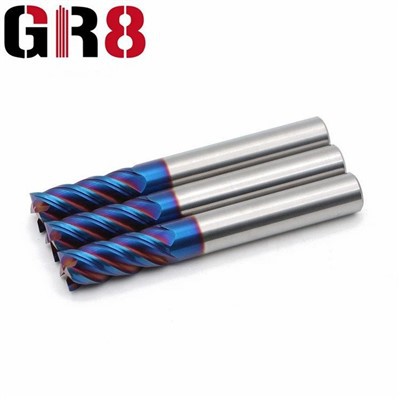
When it comes to machining operations, accurately calculating the cutting time when using a flat end mill is crucial for optimizing production efficiency, controlling costs, and ensuring high - quality results. As a flat end mill supplier, I understand the significance of this calculation for our customers in various industries such as manufacturing, woodworking, and metalworking. In this blog post, I'll walk you through the key factors and steps involved in calculating the cutting time for flat end mills.
Understanding the Basics of Flat End Mills
Before diving into the cutting time calculation, let's briefly review what flat end mills are. Flat end mills are cutting tools used in milling operations to remove material from a workpiece. They have a flat cutting edge at the end, which makes them suitable for a variety of tasks including face milling, slotting, and profiling. There are different types of flat end mills, such as Carbide End Mills, which are known for their high hardness and wear - resistance, and are often used in machining hard materials like metals.
Factors Affecting Cutting Time
Several factors influence the cutting time when using a flat end mill. Understanding these factors is essential for accurate calculation.
1. Cutting Speed (V)
Cutting speed is the speed at which the cutting edge of the end mill moves relative to the workpiece. It is usually measured in surface feet per minute (SFM) for imperial units or meters per minute (m/min) for metric units. The cutting speed depends on the material of the workpiece and the end mill. For example, when machining aluminum, a higher cutting speed can be used compared to machining steel. Different materials have recommended cutting speeds, which can be found in machining handbooks or obtained from tool manufacturers.
2. Feed Rate (f)
Feed rate is the rate at which the end mill advances into the workpiece. It is measured in inches per revolution (IPR) in imperial units or millimeters per revolution (mm/rev) in metric units. The feed rate is determined by the material of the workpiece, the diameter of the end mill, and the type of operation. A higher feed rate can reduce the cutting time, but it also needs to be balanced with the cutting force and the quality of the machined surface.
3. Depth of Cut (ap) and Width of Cut (ae)
The depth of cut is the distance the end mill penetrates into the workpiece in the axial direction, while the width of cut is the distance the end mill cuts in the radial direction. Larger depths and widths of cut generally increase the cutting time, as more material needs to be removed. However, the choice of depth and width of cut also depends on the machine's power, the strength of the end mill, and the desired surface finish.
4. Length of Cut (L)
The length of cut is the distance that the end mill travels along the workpiece during the machining operation. It is an important factor in determining the cutting time, as a longer length of cut will require more time to complete.
Calculating Cutting Time
The basic formula for calculating the cutting time (T) is as follows:
[T=\frac{L}{f\times n}]
where (L) is the length of cut, (f) is the feed rate per revolution, and (n) is the spindle speed.
However, to use this formula, we first need to calculate the spindle speed ((n)) based on the cutting speed ((V)) and the diameter of the end mill ((D)). The formula for calculating the spindle speed is:


[n=\frac{V\times12}{\pi\times D}] (for imperial units, where (V) is in SFM and (D) is in inches)
[n=\frac{1000\times V}{\pi\times D}] (for metric units, where (V) is in m/min and (D) is in mm)
Let's take an example to illustrate the calculation. Suppose we are using a flat end mill with a diameter (D = 0.5) inches to machine a workpiece with a length of cut (L= 10) inches. The recommended cutting speed (V = 200) SFM, and the feed rate (f = 0.005) IPR.
First, we calculate the spindle speed (n):
[n=\frac{V\times12}{\pi\times D}=\frac{200\times12}{\pi\times0.5}\approx1527.89\ RPM]
Then, we calculate the cutting time (T):
[T=\frac{L}{f\times n}=\frac{10}{0.005\times1527.89}\approx1.31\ minutes]
Special Considerations for Different Operations
1. Face Milling
In face milling, the width of cut can be equal to or less than the diameter of the end mill. When calculating the cutting time, we need to consider the number of passes required to cover the entire surface of the workpiece. If the width of the workpiece ((W)) is larger than the diameter of the end mill ((D)), the number of passes (N=\frac{W}{D}) (rounded up to the nearest whole number). The total length of cut for all passes needs to be calculated, and then the cutting time can be determined using the formulas mentioned above.
2. Slotting
Slotting involves cutting a narrow groove in the workpiece. The width of cut is usually equal to the diameter of the end mill. The depth of cut can be adjusted according to the requirements of the slot. In slotting, the cutting force is relatively high, so the feed rate and cutting speed need to be carefully selected to avoid tool breakage.
3. Profiling
Profiling is used to create complex shapes on the workpiece. The length of cut in profiling is the length of the profile path. The calculation of cutting time in profiling is similar to other operations, but it may require more accurate measurement of the profile length.
Importance of Accurate Cutting Time Calculation
Accurately calculating the cutting time has several benefits. Firstly, it helps in production planning. By knowing the cutting time for each operation, manufacturers can estimate the total production time and schedule their production more efficiently. Secondly, it helps in cost control. By optimizing the cutting parameters to reduce the cutting time, the cost of labor and machine usage can be minimized. Thirdly, it ensures consistent quality. By using the appropriate cutting parameters based on the cutting time calculation, the surface finish and dimensional accuracy of the machined parts can be improved.
Our Product Range
As a flat end mill supplier, we offer a wide range of products to meet the diverse needs of our customers. Our Carbide End Mills are made from high - quality carbide materials, providing excellent cutting performance and long service life. We also have Flooring & V Joint Set for woodworking applications, which can create beautiful joints and finishes. In addition, our Recoveralbe Bead Glass Door Bit Set is specifically designed for glass door manufacturing, offering precise and efficient cutting solutions.
Conclusion
Calculating the cutting time when using a flat end mill is a complex but essential task in machining operations. By understanding the key factors such as cutting speed, feed rate, depth of cut, and length of cut, and using the appropriate formulas, we can accurately estimate the cutting time. This not only helps in optimizing production efficiency and cost control but also ensures high - quality machining results.
If you are interested in our flat end mill products or need more information on cutting time calculation, please feel free to contact us for further discussion and procurement negotiation. We are committed to providing you with the best products and technical support.
References
- Machinery's Handbook, 31st Edition
- Tool Manufacturer's Catalogs
- Machining Technology textbooks