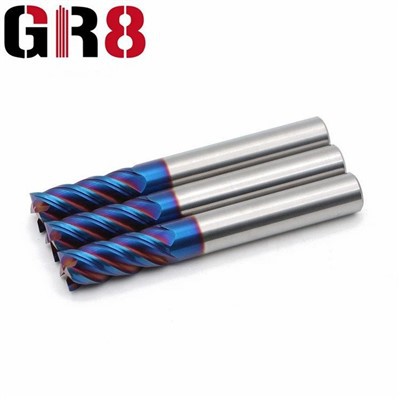
Hey there! As a supplier of 2 Flutes Flat End Mills, I've seen firsthand how crucial it is to optimize cutting parameters. It can make a huge difference in the quality of your work, the efficiency of your processes, and ultimately, your bottom line. So, let's dive into how you can get the most out of your 2 Flutes Flat End Mill by fine-tuning those cutting parameters.
Understanding the Basics
Before we start talking about optimization, let's quickly go over what cutting parameters are. They're basically the settings you use when operating a milling machine with your end mill. The main ones we'll focus on are cutting speed, feed rate, and depth of cut.
Cutting speed, measured in surface feet per minute (SFM) or meters per minute (m/min), is how fast the cutting edge of the end mill moves across the workpiece. Feed rate, measured in inches per tooth (IPT) or millimeters per tooth (mm/t), is how much the end mill advances into the material with each tooth revolution. Depth of cut is, well, how deep the end mill goes into the workpiece, usually measured in inches or millimeters.
Factors Affecting Cutting Parameters
There are several factors that can influence the ideal cutting parameters for your 2 Flutes Flat End Mill. The type of material you're cutting is a big one. Different materials, like aluminum, steel, or wood, have different hardness and machinability characteristics. For example, aluminum is generally softer and easier to cut than steel, so you can usually use higher cutting speeds and feed rates with it.
The geometry of the end mill also plays a role. A 2 Flutes Flat End Mill has its own unique design that affects how it cuts. The number of flutes, the helix angle, and the rake angle all impact the cutting performance. In the case of a 2 Flutes Flat End Mill, the two flutes are great for general-purpose milling and can handle a variety of materials.
The machine you're using is another important factor. The power, rigidity, and spindle speed capabilities of your milling machine will determine what cutting parameters are feasible. A more powerful and rigid machine can usually handle higher cutting speeds and feed rates without causing excessive vibration or tool wear.
Optimizing Cutting Speed
Let's start with cutting speed. To optimize it, you need to find the sweet spot where you're cutting fast enough to be efficient but not so fast that you damage the end mill or the workpiece.
First, refer to the manufacturer's recommendations. We, as a 2 Flutes Flat End Mill supplier, usually provide guidelines on the appropriate cutting speeds for different materials. These are a good starting point, but you may need to adjust them based on your specific situation.
If you're cutting a new material or using a different machine, you can do some trial cuts. Start at a relatively low cutting speed and gradually increase it while monitoring the cutting performance. Look for signs of excessive tool wear, like chipping or dulling of the cutting edges, or poor surface finish on the workpiece. If you notice any of these issues, you may be cutting too fast.
On the other hand, if the cutting process seems slow and the end mill isn't removing material efficiently, you can try increasing the cutting speed. Just make sure to do it in small increments and keep an eye on the tool and the workpiece.
Adjusting Feed Rate
Next up is the feed rate. Similar to cutting speed, the feed rate needs to be balanced. If it's too low, you're wasting time, and if it's too high, you can cause excessive tool wear or even break the end mill.


Again, start with the manufacturer's recommendations. But you can also consider the chip load. Chip load is the amount of material removed by each tooth of the end mill per revolution. A good rule of thumb is to aim for a chip load that's proportional to the diameter of the end mill. For a 2 Flutes Flat End Mill, a typical chip load might range from 0.001 to 0.005 inches per tooth, depending on the material and the cutting conditions.
You can adjust the feed rate based on the chip load. If the chips are too thick, you may need to decrease the feed rate. If the chips are too thin or the end mill seems to be rubbing rather than cutting, you can increase the feed rate.
Controlling Depth of Cut
The depth of cut is also an important parameter to optimize. It affects the amount of material removed per pass and the cutting forces acting on the end mill.
For a 2 Flutes Flat End Mill, a common approach is to start with a relatively shallow depth of cut and gradually increase it as you gain more confidence in the cutting process. A good starting point might be around 0.020 to 0.050 inches for roughing cuts.
When increasing the depth of cut, make sure to monitor the cutting forces. If you notice excessive vibration or the machine struggling to maintain the cutting speed and feed rate, you may need to reduce the depth of cut. On the other hand, if the end mill is cutting smoothly and the surface finish is good, you can try increasing the depth of cut to improve the efficiency of the process.
Using the Right Coolant
Coolant can also play a significant role in optimizing the cutting parameters. It helps to reduce heat and friction during the cutting process, which can extend the life of the end mill and improve the surface finish of the workpiece.
There are different types of coolant available, such as water-soluble coolants, straight oils, and synthetic coolants. The choice of coolant depends on the material you're cutting and the cutting conditions. For example, water-soluble coolants are commonly used for general-purpose machining and are good for reducing heat. Straight oils are more suitable for heavy-duty cutting operations where high lubrication is required.
Make sure to apply the coolant properly. It should be directed at the cutting zone to effectively cool and lubricate the end mill and the workpiece.
Benefits of Optimized Cutting Parameters
Optimizing the cutting parameters for your 2 Flutes Flat End Mill has several benefits. First of all, it improves the quality of your work. You'll get a better surface finish on the workpiece, which is especially important if you're making parts that require a high level of precision or aesthetics.
It also increases the efficiency of your processes. By using the right cutting speeds, feed rates, and depths of cut, you can reduce the machining time and increase the amount of material you can remove per pass. This means you can produce more parts in less time, which is great for your productivity and profitability.
Another benefit is that it extends the life of your end mill. When you're using the optimal cutting parameters, the end mill experiences less wear and tear, so it lasts longer. This saves you money on tool replacement costs in the long run.
Related Products
If you're interested in other types of end mills, we also offer Carbide End Mills. Carbide end mills are known for their high hardness and wear resistance, making them suitable for cutting tough materials.
We also have Flooring & V Joint Set and Door Frame Bit Set which are great for specific applications in the woodworking industry.
Contact for Purchase
If you're looking to optimize your cutting processes and need high-quality 2 Flutes Flat End Mills, we're here to help. We can provide you with the right products and advice on the best cutting parameters for your specific needs. Don't hesitate to contact us for a purchase discussion. We're eager to work with you and help you achieve the best results in your machining operations.
References
- "Machining Fundamentals" by various authors
- Manufacturer's technical guides for 2 Flutes Flat End Mills
- Industry research papers on cutting parameter optimization