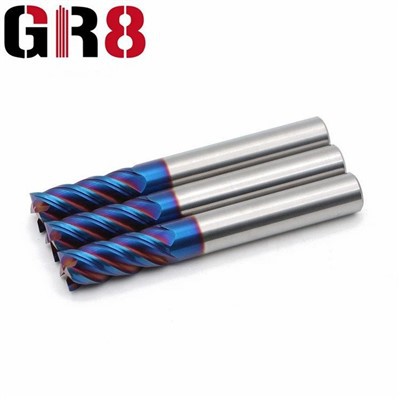
When it comes to machining stainless steel, choosing the right cutting tool and parameters is crucial for achieving optimal results. As a trusted supplier of Corn End Mill, I'm here to share some recommended cutting parameters to help you make the most of our products in stainless steel cutting operations.
Understanding Stainless Steel Machining Challenges
Stainless steel is known for its high strength, corrosion resistance, and work - hardening properties. These characteristics pose unique challenges during machining. When cutting stainless steel, the material tends to work - harden quickly, which can lead to increased cutting forces, tool wear, and poor surface finish. Additionally, stainless steel has relatively low thermal conductivity, causing heat to build up at the cutting edge, further accelerating tool wear.
The Advantages of Corn End Mills for Stainless Steel Cutting
Corn end mills are an excellent choice for machining stainless steel. They feature a rounded corner, which helps to reduce stress concentration at the cutting edge compared to square - end mills. This design minimizes the risk of chipping and increases tool life. The rounded corner also allows for smoother contouring and profiling, making it suitable for a variety of applications, such as milling pockets, slots, and 3D surfaces in stainless steel parts.
Recommended Cutting Parameters
1. Cutting Speed (Vc)
The cutting speed is the speed at which the cutting edge of the tool moves relative to the workpiece. It is typically measured in surface feet per minute (SFM) or meters per minute (m/min). For stainless steel, the recommended cutting speed for corn end mills depends on several factors, including the type of stainless steel (austenitic, ferritic, martensitic), the hardness of the material, and the coating on the tool.
- Austenitic stainless steels (e.g., 304, 316): For uncoated carbide corn end mills, a cutting speed of 80 - 120 SFM (24 - 37 m/min) is a good starting point. If the tool is coated with titanium nitride (TiN), titanium carbonitride (TiCN), or aluminum titanium nitride (AlTiN), the cutting speed can be increased to 120 - 200 SFM (37 - 61 m/min).
- Ferritic and martensitic stainless steels: These types of stainless steels are generally harder than austenitic grades. For uncoated carbide tools, a cutting speed of 60 - 100 SFM (18 - 30 m/min) is recommended. Coated tools can operate at speeds of 100 - 180 SFM (30 - 55 m/min).
2. Feed per Tooth (fz)
The feed per tooth is the distance the tool advances into the workpiece for each tooth of the end mill during one revolution. It is measured in inches per tooth (ipt) or millimeters per tooth (mm/t). The feed per tooth should be carefully selected to balance material removal rate and tool life.
- For roughing operations in stainless steel, a feed per tooth of 0.002 - 0.005 ipt (0.05 - 0.13 mm/t) is typical. This allows for efficient material removal while minimizing tool wear.
- For finishing operations, a lower feed per tooth of 0.001 - 0.003 ipt (0.03 - 0.08 mm/t) is recommended to achieve a better surface finish.
3. Depth of Cut (ap) and Width of Cut (ae)
The depth of cut is the distance the tool penetrates into the workpiece along the axial direction, while the width of cut is the distance the tool engages the workpiece along the radial direction.
- In roughing, a depth of cut of 0.1 - 0.2 inches (2.5 - 5 mm) and a width of cut of 0.05 - 0.1 inches (1.3 - 2.5 mm) can be used. This provides a good balance between material removal rate and tool stability.
- For finishing, a shallower depth of cut of 0.01 - 0.05 inches (0.25 - 1.3 mm) and a narrow width of cut of 0.01 - 0.03 inches (0.25 - 0.76 mm) are preferred to obtain a smooth surface finish.
Coolant and Lubrication
Proper coolant and lubrication are essential when cutting stainless steel. Coolants help to dissipate heat generated during the cutting process, reduce tool wear, and improve surface finish. There are two main types of coolants: flood coolant and mist coolant.
- Flood coolant: This method involves flooding the cutting area with a large volume of coolant. It is effective in removing heat and chips from the cutting zone. Water - soluble coolants are commonly used for stainless steel machining. They provide good cooling and lubrication properties.
- Mist coolant: Mist coolant is applied as a fine mist to the cutting area. It is more environmentally friendly and can be more cost - effective than flood coolant. However, it may not be as effective in cooling large - scale machining operations.
In addition to coolants, some manufacturers also recommend using cutting oils or lubricants to reduce friction between the tool and the workpiece. These lubricants can be applied directly to the tool or workpiece before machining.


Tool Selection and Coating
When choosing a corn end mill for stainless steel cutting, consider the following factors:
- Tool Material: Carbide is the most common material for end mills used in stainless steel machining due to its high hardness and wear resistance.
- Coating: As mentioned earlier, coatings such as TiN, TiCN, and AlTiN can significantly improve tool life and cutting performance. AlTiN coatings are particularly suitable for high - speed machining of stainless steel because they have excellent thermal stability and oxidation resistance.
Other End Mills for Wood and Their Applications
In addition to corn end mills, we also offer a range of other end mills for wood applications. For example, Compression End Mill is designed to prevent tear - out on both the top and bottom surfaces of the wood workpiece. It is ideal for milling plywood, veneer, and other laminated materials. Straight Flutes Engraving End Mills are suitable for fine engraving and detailed work on wood surfaces.
Conclusion
Cutting stainless steel with a corn end mill requires careful consideration of cutting parameters, tool selection, and coolant/lubrication. By following the recommended cutting parameters outlined in this blog, you can achieve efficient material removal, long tool life, and high - quality surface finishes. If you have any questions about our Corn End Mill products or need further assistance in selecting the right tool for your application, please don't hesitate to contact us. We are committed to providing you with the best solutions for your machining needs.
References
- "Machining Stainless Steel: A Practical Guide", Industrial Press Inc.
- "Cutting Tool Applications", Society of Manufacturing Engineers.