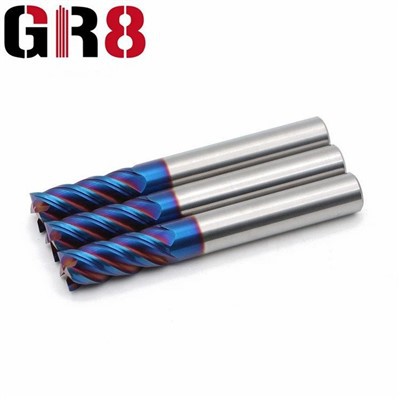
End mills are indispensable cutting tools in the manufacturing and machining industries, used for a wide range of operations such as slotting, profiling, and facing. Among the various types of end mills, straight flutes end mills stand out with their unique characteristics and applications. As a supplier of straight flutes end mills, I am well - versed in the differences between straight flutes end mills and other end mills, which I will elaborate on in this blog.
Geometric Design
The most obvious difference between straight flutes end mills and other end mills lies in their flute design. Straight flutes end mills have flutes that run parallel to the axis of the tool. This simple yet effective design is quite different from other end mills like helical flutes end mills, where the flutes are spiraled around the tool.
Helical flutes end mills are further classified into right - hand and left - hand helix. The helical design allows for a more gradual and smooth cutting action. As the tool rotates, the helix helps to lift the chips out of the cut, reducing the chances of chip recutting and improving surface finish. In contrast, straight flutes end mills have a more straightforward cutting action. They are more suitable for applications where a high level of precision in straight cuts is required, such as engraving. Our Straight Flutes Engraving End Mills are specifically designed with straight flutes to ensure accurate and clean engraving results.
Another type of end mill is the ball - nose end mill. The tip of a ball - nose end mill is hemispherical, which is in sharp contrast to the flat or square tip of straight flutes end mills. Ball - nose end mills are ideal for machining 3D contours and curved surfaces, as their rounded tip can smoothly follow the shape of the workpiece. Straight flutes end mills, on the other hand, are better for flat - bottomed cuts and operations where a square - edged finish is desired.
Cutting Performance
The cutting performance of straight flutes end mills and other end mills also varies significantly. Straight flutes end mills typically generate more cutting forces compared to helical flutes end mills. The parallel flutes do not provide the same chip - evacuation advantage as helical flutes. As a result, when using straight flutes end mills, operators need to be more cautious about chip management to avoid chip jamming, which can lead to tool breakage and poor surface finish.

Helical flutes end mills, with their chip - lifting ability, can generally operate at higher feed rates and spindle speeds. They are more efficient in removing large amounts of material quickly, making them a popular choice for roughing operations. Straight flutes end mills, however, excel in finishing operations where precision and a clean cut are crucial. For example, when engraving detailed patterns on a workpiece, the straight flutes ensure that the edges of the engraving are sharp and well - defined. Our Straight Flutes Engraving End Mills are crafted to provide high - precision engraving results, making them a top choice for artisans and manufacturers in the woodworking and jewelry industries.
Compression end mills, as the name suggests, are designed to compress the material during cutting. They have a unique combination of up - cut and down - cut flutes, which helps to prevent delamination in materials such as plywood. This is a significant advantage over straight flutes end mills, which do not have this anti - delamination feature. Compression end mills are commonly used in woodworking applications where a clean cut on both the top and bottom surfaces of the workpiece is required. You can learn more about Compression End Mill on our website.
Material Compatibility
Different end mills are suitable for different materials, and straight flutes end mills are no exception. Straight flutes end mills are often used for softer materials such as wood, plastics, and some non - ferrous metals. The relatively simple cutting action of straight flutes is less likely to cause excessive heat build - up in these materials, which can lead to melting or deformation.
Helical flutes end mills, on the other hand, are more versatile in terms of material compatibility. They can be used for a wide range of materials, from soft plastics to hard metals like steel and titanium. The chip - evacuation ability of helical flutes is particularly beneficial when machining hard materials, as it helps to reduce the heat generated during cutting and prevent tool wear.
Ball - nose end mills are also commonly used for machining a variety of materials, especially when creating 3D shapes. They are often used in the aerospace and automotive industries for machining complex parts made of high - strength alloys.
Application Areas
The differences in design, cutting performance, and material compatibility translate into different application areas for straight flutes end mills and other end mills. Straight flutes end mills are widely used in engraving, fine - detail work, and precision machining. In the woodworking industry, they are used for creating inlays, lettering, and decorative patterns. In the jewelry industry, straight flutes end mills are used for engraving intricate designs on precious metals.
Helical flutes end mills are mainly used for roughing and semi - finishing operations. They are commonly employed in the manufacturing of large - scale components, such as engine blocks and structural parts. The high - speed material removal capabilities of helical flutes end mills make them ideal for these types of applications.

Compression end mills are specifically designed for woodworking applications, especially when working with laminated materials. They are used in the production of cabinets, furniture, and other wood products where delamination is a concern.
Tool Life and Cost
Tool life is an important consideration in machining operations. Straight flutes end mills, due to their relatively simple design, are generally less expensive to manufacture compared to some other types of end mills, such as helical flutes end mills with complex geometries. However, their tool life can be shorter, especially when used for high - volume or high - stress applications. The lack of effective chip evacuation can lead to increased tool wear and breakage.
Helical flutes end mills, although more expensive, often have a longer tool life. The chip - evacuation feature reduces the heat and stress on the tool, which helps to extend its lifespan. Ball - nose end mills and compression end mills also tend to have a relatively long tool life, thanks to their specialized designs for specific applications.
Conclusion
In conclusion, straight flutes end mills have distinct differences from other end mills in terms of geometric design, cutting performance, material compatibility, application areas, tool life, and cost. As a supplier of straight flutes end mills, we understand the unique requirements of our customers and offer high - quality products that are tailored to specific applications. Whether you are looking for precise engraving tools or need to perform fine - detail work, our straight flutes end mills are the ideal choice.
If you are interested in learning more about our straight flutes end mills or have any questions regarding your machining needs, we encourage you to reach out to us for a procurement discussion. We are committed to providing you with the best cutting solutions and excellent customer service.
References
- "Cutting Tool Engineering Handbook"
- "Machining Fundamentals and Applications"