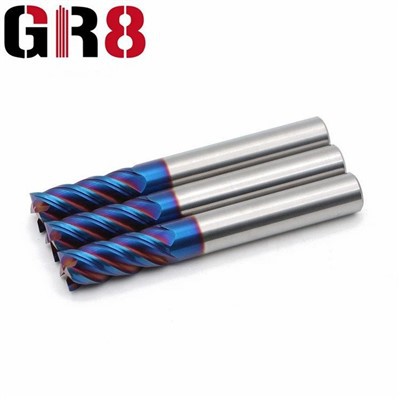
Hey there! As a supplier of solid carbide flat cutters, I've been in the game for quite a while, and I often get asked about the quality control standards for these cutters. So, I thought I'd share some insights with you all.
First off, let's talk about what solid carbide flat cutters are. These are cutting tools made from solid carbide, a super - hard material composed of tungsten carbide and a binder metal like cobalt. They're used in a wide range of applications, from machining metals to woodworking, and even in the plastics industry.
Material Quality
The quality of the carbide material is the foundation of a good solid carbide flat cutter. High - quality carbide has a uniform grain structure. A fine - grained carbide is generally preferred because it offers better wear resistance and edge sharpness. The purity of the raw materials also matters a great deal. Any impurities in the carbide can lead to premature tool failure. For example, if there are small inclusions of other metals or non - metallic substances, they can act as stress concentrators, causing the cutter to chip or break during use.
We source our carbide from trusted suppliers who adhere to strict quality control measures. Before we start the manufacturing process, we conduct our own tests on the incoming carbide rods. We use techniques like X - ray diffraction to analyze the crystal structure and ensure that it meets our standards. This way, we can be confident that the base material for our cutters is of the highest quality.
Geometric Accuracy
The geometric accuracy of a solid carbide flat cutter is crucial for its performance. This includes parameters such as the diameter, length, and helix angle. The diameter of the cutter must be within a very tight tolerance. Even a slight deviation in diameter can lead to inaccurate machining results. For instance, if you're milling a hole and the cutter diameter is larger than specified, the hole will be over - sized, and if it's smaller, the hole will be under - sized.
The length of the cutter also needs to be precise. In applications where deep milling is required, an incorrect cutter length can lead to problems such as insufficient cutting depth or interference with the workpiece fixture. The helix angle affects the chip evacuation and cutting forces. A proper helix angle ensures that chips are removed efficiently from the cutting zone, reducing the chances of chip recutting and improving the surface finish of the machined part.
We use advanced CNC grinding machines to manufacture our cutters, which can achieve extremely high levels of geometric accuracy. After grinding, we measure each cutter using coordinate measuring machines (CMMs). These machines can measure the dimensions of the cutter with an accuracy of a few micrometers, allowing us to ensure that every cutter meets our strict geometric specifications.
Edge Sharpness and Integrity
The sharpness of the cutting edge is what allows a solid carbide flat cutter to make clean cuts. A sharp edge reduces the cutting forces, improves the surface finish, and extends the tool life. We use state - of - the - art grinding wheels and grinding processes to create sharp edges on our cutters.


However, sharpness alone is not enough. The edge also needs to have good integrity. This means that it should be able to withstand the cutting forces without chipping or breaking. We perform edge integrity tests on our cutters. One common test is the scratch test, where we use a diamond stylus to make a controlled scratch on the cutting edge. By analyzing the scratch pattern, we can determine the edge's resistance to chipping.
Coating Quality
Many of our solid carbide flat cutters are coated to enhance their performance. Coatings can provide benefits such as increased wear resistance, reduced friction, and improved heat dissipation. There are different types of coatings available, such as titanium nitride (TiN), titanium carbonitride (TiCN), and aluminum titanium nitride (AlTiN).
The quality of the coating is essential. A well - applied coating should be uniform in thickness and have good adhesion to the carbide substrate. If the coating is too thick, it may peel off during use, and if it's too thin, it won't provide the desired benefits. We use physical vapor deposition (PVD) techniques to apply our coatings. This process allows us to have precise control over the coating thickness and composition.
After coating, we conduct adhesion tests. One such test is the Rockwell indentation test, where we make an indentation on the coated surface using a Rockwell indenter. By examining the area around the indentation, we can determine the coating's adhesion strength.
Performance Testing
Before our solid carbide flat cutters leave the factory, we subject them to rigorous performance tests. We use actual machining operations to simulate real - world conditions. For example, we might mill a block of steel or aluminum to evaluate the cutter's cutting performance, surface finish, and tool life.
We measure the cutting forces using dynamometers during these tests. High cutting forces can indicate problems such as dull edges or improper cutter geometry. We also analyze the surface finish of the machined part using surface profilometers. A smooth surface finish is a sign of a well - performing cutter.
Our Product Range
We offer a wide range of solid carbide flat cutters to meet different customer needs. For example, our Door Frame Bit Set is specifically designed for door frame machining. It provides excellent cutting performance and long tool life, making it a popular choice among woodworking professionals.
Our Other Handrail Bit is suitable for handrail manufacturing. It can handle different types of wood and plastics, delivering precise and clean cuts. And our 55HRC 4 Flutes Flat End Mill is ideal for high - speed machining of hard materials. With its four flutes, it offers high metal removal rates and good surface finish.
Contact Us for Purchasing
If you're in the market for high - quality solid carbide flat cutters, we'd love to hear from you. Whether you're a small - scale workshop or a large - scale manufacturing plant, we can provide you with the right cutters for your needs. Our quality control standards ensure that you'll get reliable and high - performing tools. So, don't hesitate to reach out to us for a quote or to discuss your specific requirements.
References
- "Cutting Tool Engineering Handbook" by Peter K. Wright and David A. Wakelin
- "Manufacturing Engineering and Technology" by Serope Kalpakjian and Steven R. Schmid