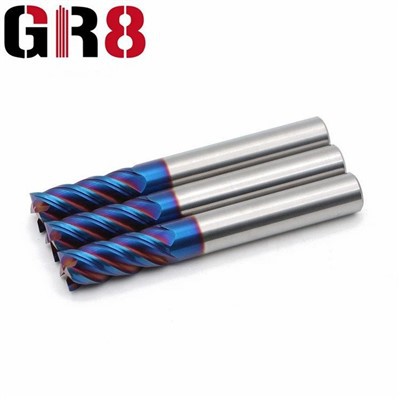
Interrupted cutting is a common machining process in various industries, such as automotive, aerospace, and general manufacturing. It involves cutting through a workpiece that has discontinuities, like holes, slots, or uneven surfaces. Using a long neck end mill for interrupted cutting can offer certain advantages, such as reaching deep cavities or machining in hard - to - access areas. However, it also comes with a set of unique challenges. As a long neck end mill supplier, I have witnessed these challenges firsthand and would like to share some insights.
1. Vibration and Deflection
One of the most significant challenges when using a long neck end mill for interrupted cutting is vibration and deflection. The long neck design of the end mill increases its length - to - diameter ratio. A higher length - to - diameter ratio makes the end mill more flexible and prone to bending under cutting forces.
During interrupted cutting, the cutting forces change rapidly as the tool enters and exits the material. These sudden changes in force can cause the long neck end mill to vibrate. Vibration not only affects the surface finish of the workpiece but also reduces the tool life. Excessive vibration can lead to premature wear of the cutting edges, chipping, and even breakage of the end mill.
For example, in a machining operation where a long neck end mill is used to cut through a workpiece with multiple holes, each time the tool enters and exits a hole, the cutting force changes abruptly. This can set up a resonance in the long neck, causing it to vibrate violently. To mitigate this issue, proper toolholding systems are crucial. Using high - quality collets or hydraulic chucks can help to reduce vibration by providing a more secure grip on the end mill. Additionally, optimizing the cutting parameters, such as reducing the feed rate and cutting speed, can also help to minimize the cutting forces and thus reduce vibration.
2. Tool Life
Tool life is another major challenge when using long neck end mills for interrupted cutting. The combination of the long neck's increased flexibility and the rapid changes in cutting forces during interrupted cutting can lead to accelerated wear of the end mill.
The cutting edges of the end mill are subjected to high stress during interrupted cutting. Each time the tool engages with the material, it experiences a shock load. Over time, these shock loads can cause the cutting edges to wear out, become dull, or chip. The long neck also makes it more difficult for the coolant to reach the cutting zone effectively. Coolant is essential for removing heat and chips from the cutting area, and poor coolant delivery can lead to overheating of the end mill, further reducing its tool life.
A 2 Flutes Ball Nose Long Neck End Mill is often used in interrupted cutting applications. However, due to the challenges mentioned above, its tool life may be shorter compared to a standard end mill in continuous cutting operations. To improve tool life, using end mills with high - performance coatings can be beneficial. Coatings such as TiAlN (Titanium Aluminum Nitride) or TiCN (Titanium Carbonitride) can increase the hardness and wear resistance of the cutting edges. Moreover, ensuring proper coolant delivery through the use of through - tool coolant systems or external coolant nozzles can help to extend the tool life by keeping the cutting edges cool and removing chips efficiently.
3. Chip Evacuation
Chip evacuation is a critical aspect of any machining process, and it becomes even more challenging when using long neck end mills for interrupted cutting. The long neck can act as an obstacle to the smooth flow of chips out of the cutting area.
During interrupted cutting, chips are formed in short, irregular segments. These chips need to be removed from the cutting zone quickly to prevent them from re - cutting and causing damage to the workpiece and the end mill. The long neck can restrict the movement of chips, causing them to accumulate in the cutting area. This can lead to chip clogging, which can increase the cutting forces, generate more heat, and ultimately result in poor surface finish and reduced tool life.
To address the chip evacuation issue, end mills with optimized flute designs can be used. For example, end mills with variable helix flutes can help to break up the chips and improve their evacuation. Additionally, using a higher feed rate can sometimes help to push the chips out of the cutting area more effectively. However, this needs to be balanced with the risk of increasing the cutting forces and vibration.


4. Accuracy and Precision
Maintaining accuracy and precision is a challenge when using long neck end mills for interrupted cutting. The vibration and deflection mentioned earlier can cause deviations in the machining dimensions.
The long neck end mill's flexibility can lead to a loss of positional accuracy. When the tool deflects under cutting forces, it may not cut the workpiece exactly where it is intended to. This can result in dimensional errors, especially in applications where tight tolerances are required. In interrupted cutting, the sudden changes in cutting forces can also cause the tool to move slightly, further affecting the accuracy of the machining.
To ensure accuracy and precision, it is important to use a rigid machine tool. A machine with high stiffness can better withstand the cutting forces and reduce the deflection of the long neck end mill. Additionally, using in - process measurement systems can help to monitor the machining dimensions in real - time and make adjustments as needed.
5. Material Compatibility
Not all materials are equally suitable for interrupted cutting with long neck end mills. Some materials, such as hardened steels or high - strength alloys, can be particularly challenging to machine.
These materials have high hardness and strength, which means that the cutting forces during interrupted cutting are even higher. The long neck end mill may struggle to cut through these materials without experiencing excessive wear or breakage. Moreover, some materials may have a tendency to work - harden during machining. This can further increase the cutting forces and make it more difficult for the long neck end mill to maintain its cutting performance.
When machining difficult - to - cut materials, it is important to select the right grade of carbide for the end mill. Carbide grades with high toughness and wear resistance are more suitable for interrupted cutting of hard materials. Additionally, using specialized cutting fluids can help to reduce the cutting forces and improve the machinability of these materials.
Conclusion
Using long neck end mills for interrupted cutting offers unique opportunities for machining in hard - to - reach areas, but it also presents several challenges. Vibration and deflection, tool life, chip evacuation, accuracy and precision, and material compatibility are all factors that need to be carefully considered.
As a long neck end mill supplier, I understand the importance of providing solutions to these challenges. By offering high - quality end mills with optimized designs, coatings, and proper toolholding systems, we can help our customers to overcome these difficulties and achieve better machining results.
If you are facing challenges in your interrupted cutting applications with long neck end mills or are interested in exploring the best solutions for your specific needs, I encourage you to contact us for a detailed discussion. Our team of experts is ready to assist you in selecting the right long neck end mill and optimizing your machining processes.
References
- Boothroyd, G., & Knight, W. A. (2006). Fundamentals of Machining and Machine Tools. CRC Press.
- Kalpakjian, S., & Schmid, S. R. (2013). Manufacturing Engineering and Technology. Pearson.
- Trent, E. M., & Wright, P. K. (2000). Metal Cutting. Butterworth - Heinemann.