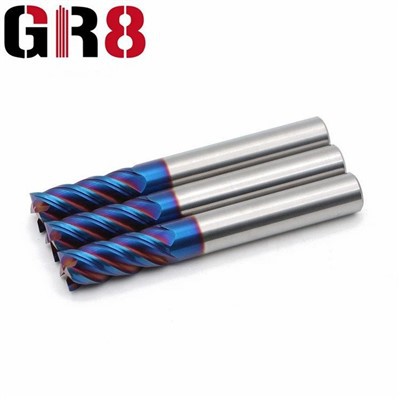
The surface finish achievable with a Taper Ball Nose Endmill is a crucial aspect that significantly impacts the quality of machined parts. As a supplier of Taper Ball Nose Endmills, I am well - versed in the factors that influence the surface finish and the level of quality that can be attained.
Understanding Taper Ball Nose Endmills
Taper Ball Nose Endmills are specialized cutting tools used in machining operations, particularly in milling complex 3D shapes, contours, and free - form surfaces. The taper design allows for more efficient material removal in areas where a standard ball nose endmill may not be as effective, while the ball nose provides a smooth cutting edge for finishing operations.
Factors Affecting Surface Finish
Tool Geometry
The geometry of a Taper Ball Nose Endmill plays a vital role in determining the surface finish. The taper angle affects the cutting forces and the chip evacuation. A smaller taper angle may result in smoother cuts as it reduces the lateral forces on the tool. The radius of the ball nose also matters; a larger radius can provide a better surface finish because it spreads the cutting forces over a larger area, reducing the likelihood of tool marks on the workpiece.
Cutting Parameters
Cutting parameters such as cutting speed, feed rate, and depth of cut have a direct impact on the surface finish. Higher cutting speeds generally lead to better surface finishes as long as the tool and the machine can handle the heat generated. However, if the cutting speed is too high, it may cause tool wear and result in a poor surface finish. The feed rate determines how fast the tool moves across the workpiece. A lower feed rate usually results in a smoother surface finish, but it also increases the machining time. The depth of cut affects the amount of material removed in each pass. A shallower depth of cut can contribute to a better surface finish as it reduces the stress on the tool and the workpiece.


Workpiece Material
Different workpiece materials respond differently to the cutting action of a Taper Ball Nose Endmill. Soft materials like aluminum may result in a smoother surface finish compared to hard materials such as stainless steel or titanium. Hard materials are more difficult to cut, and they can cause more wear on the tool, which may affect the surface finish. The microstructure of the workpiece material also plays a role. Materials with a uniform grain structure are generally easier to machine and can result in a better surface finish.
Tool Coating
Tool coating can significantly improve the surface finish achievable with a Taper Ball Nose Endmill. A coated endmill can reduce friction between the tool and the workpiece, which in turn reduces the cutting forces and the heat generated during machining. This leads to less tool wear and a better surface finish. For example, a titanium nitride (TiN) coating can increase the hardness of the tool and improve its wear resistance. We offer 2F Taper Ball Nose Endmill with Coating and 2F Taper Ball Nose Endmill With Coating which are designed to provide excellent surface finishes on a variety of workpiece materials.
Achievable Surface Finishes
The surface finish achievable with a Taper Ball Nose Endmill can vary depending on the factors mentioned above. In general, for soft materials like aluminum, a surface finish of Ra 0.4 - 0.8 micrometers can be achieved under optimal cutting conditions. This level of surface finish is considered very good and is suitable for many applications where a smooth surface is required.
For harder materials such as stainless steel, a surface finish of Ra 0.8 - 1.6 micrometers is more typical. Achieving a better surface finish on hard materials requires more precise control of the cutting parameters and the use of high - quality tools. Our 2F Taper Ball Nose Milling Cutter Without Coating can be used for general machining operations on a variety of materials, and with proper adjustment of the cutting parameters, it can provide a satisfactory surface finish.
Measuring Surface Finish
To ensure that the desired surface finish is achieved, it is essential to measure the surface roughness. There are several methods available for measuring surface finish, including profilometry and optical methods. Profilometry involves dragging a stylus across the surface of the workpiece and measuring the height variations. Optical methods use light to measure the surface topography. These measurements can help in adjusting the cutting parameters and the tool selection to improve the surface finish.
Tips for Improving Surface Finish
- Tool Selection: Choose the right Taper Ball Nose Endmill based on the workpiece material, the complexity of the shape, and the desired surface finish. Consider factors such as the taper angle, ball nose radius, and the number of flutes.
- Cutting Parameter Optimization: Experiment with different cutting speeds, feed rates, and depths of cut to find the optimal combination for the best surface finish. Use cutting fluid to reduce friction and heat.
- Machine Maintenance: Ensure that the machine tool is in good working condition. A well - maintained machine can provide more stable cutting conditions, which is essential for achieving a good surface finish.
- Tool Maintenance: Regularly inspect the Taper Ball Nose Endmill for wear and damage. Replace the tool when necessary to maintain the surface finish quality.
Conclusion
The surface finish achievable with a Taper Ball Nose Endmill is influenced by multiple factors, including tool geometry, cutting parameters, workpiece material, and tool coating. By understanding these factors and following the tips for improving surface finish, it is possible to achieve high - quality surface finishes on a variety of materials. As a supplier of Taper Ball Nose Endmills, we are committed to providing our customers with the best tools and technical support to help them achieve their machining goals.
If you are looking for high - quality Taper Ball Nose Endmills for your machining operations, please feel free to contact us for more information and to discuss your specific requirements. We are ready to assist you in finding the most suitable tools for your applications.
References
- Boothroyd, G., & Knight, W. A. (2006). Fundamentals of Machining and Machine Tools. Marcel Dekker.
- Kalpakjian, S., & Schmid, S. R. (2009). Manufacturing Engineering and Technology. Pearson Prentice Hall.
- Trent, E. M., & Wright, P. K. (2000). Metal Cutting. Butterworth - Heinemann.