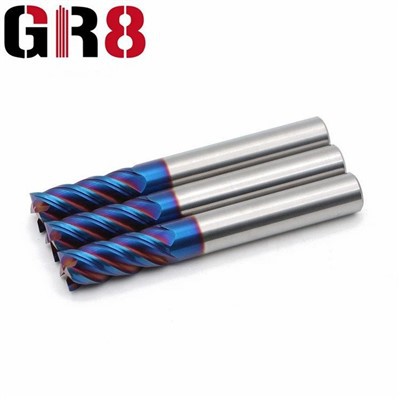
Are there any limitations to using a corner radius end mill?
In the world of machining and milling operations, corner radius end mills are indispensable tools. As a supplier of corner radius end mills, I've witnessed firsthand their remarkable capabilities and the value they bring to various industries. However, like any tool, they come with certain limitations. Understanding these limitations is crucial for machinists and manufacturers to make informed decisions and optimize their machining processes.
1. Material Compatibility
One of the primary limitations of corner radius end mills lies in their material compatibility. Different materials have varying hardness, toughness, and machinability characteristics. While corner radius end mills are designed to handle a wide range of materials, including metals, plastics, and composites, there are limits to their effectiveness.
For instance, when machining extremely hard materials such as hardened steel or titanium, the cutting edges of the end mill can wear out quickly. The high cutting forces and heat generated during the machining process can cause premature tool failure, leading to increased tooling costs and reduced productivity. In such cases, specialized cutting tools with advanced coatings or geometries may be required to achieve optimal results.

On the other hand, machining soft materials like aluminum or brass can also pose challenges. The low melting point of these materials can cause them to stick to the cutting edges of the end mill, resulting in built-up edge (BUE) formation. BUE can affect the surface finish of the workpiece and reduce the accuracy of the machining operation. To mitigate this issue, using appropriate cutting fluids and optimizing the cutting parameters can help minimize BUE formation.
2. Cutting Depth and Width
Another limitation of corner radius end mills is their cutting depth and width capabilities. The corner radius of the end mill determines the maximum cutting depth and width that can be achieved without causing excessive tool deflection or breakage. As the cutting depth or width increases, the cutting forces acting on the end mill also increase, which can lead to tool failure if the end mill is not properly selected or used.
For example, a small-diameter corner radius end mill with a large corner radius may not be suitable for deep or wide cuts. The increased cutting forces can cause the end mill to deflect, resulting in poor surface finish and dimensional accuracy. In such cases, using a larger-diameter end mill or reducing the cutting depth and width may be necessary to ensure stable machining.
3. Surface Finish
While corner radius end mills are capable of producing excellent surface finishes, there are limitations to the quality of the surface finish that can be achieved. The surface finish of the workpiece is influenced by several factors, including the cutting parameters, the material being machined, and the condition of the cutting edges of the end mill.

In some cases, the corner radius of the end mill can leave a small radius at the bottom of the machined feature, which may not be desirable for certain applications. Additionally, if the cutting edges of the end mill are worn or damaged, it can result in a rough surface finish. To achieve a high-quality surface finish, it is important to select the appropriate cutting parameters, use sharp cutting edges, and maintain the end mill properly.
4. Cost
Cost is another factor to consider when using corner radius end mills. Compared to other types of end mills, corner radius end mills can be more expensive due to their complex geometry and the precision required in their manufacturing. Additionally, the cost of tooling can increase significantly if the end mills need to be replaced frequently due to wear or breakage.

However, it is important to note that the cost of using corner radius end mills should be evaluated in the context of the overall machining process. In many cases, the benefits of using corner radius end mills, such as improved surface finish, increased productivity, and reduced tool wear, can outweigh the initial cost of the tooling.
5. Availability of Sizes and Geometries
The availability of sizes and geometries can also be a limitation when using corner radius end mills. While there is a wide range of corner radius end mills available on the market, not all sizes and geometries may be readily available. This can be a problem for machinists and manufacturers who require a specific size or geometry for their machining operations.
In some cases, custom-made corner radius end mills may be required to meet the specific needs of a particular application. However, custom-made end mills can be expensive and may have a longer lead time, which can affect the production schedule.
Despite these limitations, corner radius end mills remain a popular choice for many machining applications. Their ability to produce smooth, rounded corners and edges makes them ideal for a variety of industries, including aerospace, automotive, medical, and mold making. At our company, we offer a wide range of corner radius end mills, including Beading Bit and 4 Flutes Corner Radius End Mill and 4 Flutes Corner Radius End Mill, to meet the diverse needs of our customers.
If you are interested in learning more about our corner radius end mills or have any questions about their limitations and applications, please feel free to contact us. Our team of experts is always ready to assist you in selecting the right tool for your machining needs and optimizing your machining processes. We look forward to the opportunity to work with you and help you achieve your manufacturing goals.
References
- Trent, E. M., & Wright, P. K. (2000). Metal cutting. Butterworth-Heinemann.
- Shaw, M. C. (2005). Metal cutting principles. Oxford University Press.
- Stephenson, D. A., & Agapiou, J. S. (2006). Metal cutting theory and practice. CRC Press.